
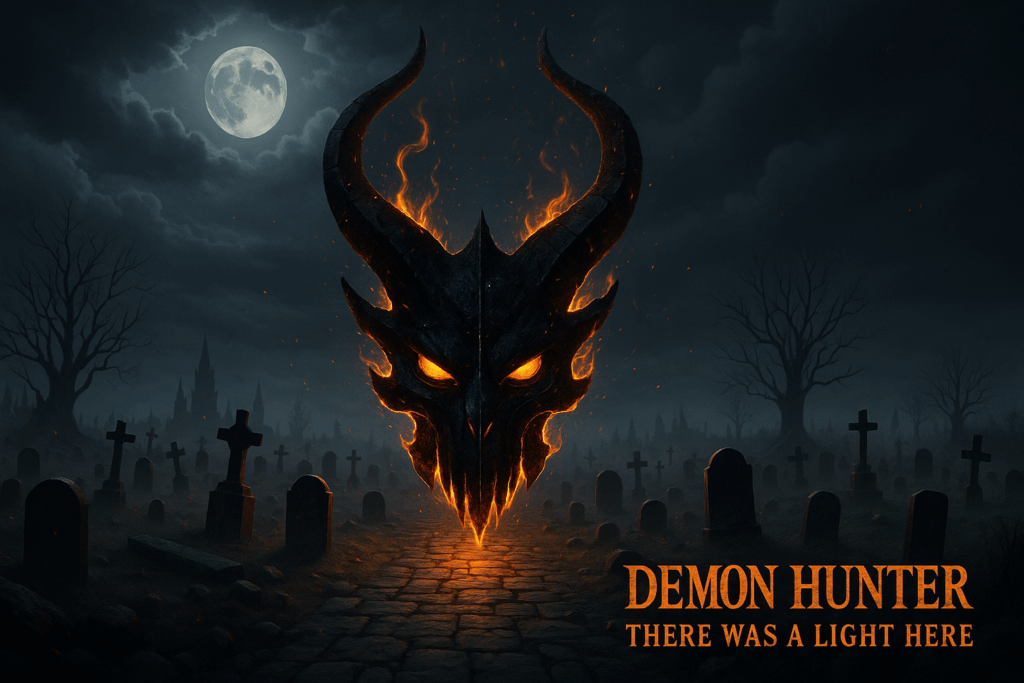
I am an agnostic who writes about the philosophical problem of suffering and the theological weight of pop culture. And just last week, I was bawling in my car, completely undone by a Christian metal album. The album is “There Was a Light Here” by Demon Hunter.
I found Demon Hunter on the eve of Easter 2015. I was a devout believer, searching for music to fill the heavy void in my rotation… and they became my answer. Four years later, when I lost my mother in February 2019, their song “Dead Flowers” took on a new level of significance in my journey, a defining song that would eventually get me through that very grief. Their music is forever engraved upon my heart.
Over the last decade, I’ve left the church, wrestled with my faith, and embraced the rigorous questioning that led me to embracing agnosticism. Yet, Demon Hunter has remained; their lyrics, deeply philosophical and never preachy, always seemed to understand the darkness better than the sermons I grew up with.
But their newest album, There Was a Light Here, is something else entirely. Written after the band’s singer lost his mother, it is a raw, unflinching theological excavation of sorrow. It gave me the same punch “Dead Flowers” did years ago, only ten times harder. The present album is, quite simply, a rare and perfect masterpiece.
This is not a typical fan review. This is especially an examination of grief as a theological process, and how this album confronts the problem of suffering…. with a brutal honesty that few artists of any faith ever achieve. It is the sound of a fractured heart finding its true voice. And I declare it is a necessary listen for anyone who has ever found their place in the dirt.
“Sorrow Light the Way”: Knowledge as a Burden
The record’s track “Sorrow Light the Way” declares that the path forward isn’t illuminated by simple faith, but the devastating reality of the loss itself. Which, of course, echoes a key challenge found in the Old Testament’s Wisdom literature: Ecclesiastes 1:18. It states: “For in much wisdom is much vexation, and he who increases knowledge increases sorrow” (NRSVue).
Indeed, this is the core essence of profound grief. The more we knew and loved the person, the more knowledge we carry, and thus, the more sorrow we hold. The song never asks us to move past the sorrow; it forces us to accept that the sorrow is the way, the unavoidable companion on this new path. It’s an inversion of the typical spiritual journey; here, the darkness is the guide. The beautifully sung chorus is a guaranteed goosebump-giver.
“The Pain in Me is Gone”: The Numbness of Shock
Following this raw declaration is “The Pain in Me is Gone,” a chillingly clinical depiction of the shock phase of trauma. This is where the sheer magnitude of the loss induces a terrifying numbness. You know you’re bleeding out, but your body and mind have severed the feeling as a protective mechanism. This song captures that eerie, empty space where you are stripped of sensation… though acutely aware that the pain is still there, lurking beneath the surface. There is no relief, just the existential shock, and the music becomes the audible manifestation of this internal trauma.
Rejection of Legalism and Comfort
The emotional devastation quickly turns outward to confront the external forces that fail the grieving soul. This section is where the album directly challenges the neat and pretty narratives often imposed by religion and society.
“I’m Done”: The True Groove of Existential Futility
“I’m Done” articulates the exhaustive fatigue of grief. This track embodies the pure hebel of Ecclesiastes, the feeling that all is “vanity,” “meaninglessness,” or “a chasing after wind.” It’s a phase in grief where you are just sick of the effort, sick of the platitudes, and sick of the entire, futile human experience. The song features a fairly upbeat tone, which stands stands in sharp, brilliant contrast to the crushing lyrical message. This paradoxical sound captures the feeling of being emotionally paralyzed while the rhythm of life continues to drag you along.
“My Place in the Dirt”: The Cold, Hard Truth
“My Place in the Dirt” is the most fierce, bold, and necessary critique on the entire album. For me, this track is the thesis statement on surviving profound loss. It directly confronts the superficiality of faith that tries to insulate itself from real pain. The lyrics contrast those who find “escape in the walls of a church” and the messy, honest path of the truly wounded:
I buried my hands in a mountain of hurt
Drank with the wicked for all that it’s worth
You found escape in the walls of a church
You found desertion I found my place in the dirt1
The agonizing path to agnosticism and relentless questioning was my own “place in the dirt.” This song, from a Christian band, is a rare and powerful affirmation for those who embrace the depravity and the brokenness, not seeing the concept that “all will be made new.” It acknowledges the darkness without becoming consumed by it (John 1:5). It rejects the holier-than-thou façade and accepts the messy reality of trauma as a profound badge of honor.
The Sorrowful Conclusion
If “My Place in the Dirt” is the intellectual thesis, the closing track is the truly unforgettable emotional core that cracks the dam.
Before the final track, I must share a small piece of personal history. Weeks before my mother died, I had given her a bunch of roses that were on sale at the grocery store I worked at. I thought it was a small gesture, but she loved them. She was in the process of drying them out before the unthinkable happened. When she passed, my sister found those flowers and gave them to me. These “dead flowers” now sit in a shadow box, along with the emerald green ribbon I made and wore at her funeral. Demon Hunter’s song “Dead Flowers” was a lifeline that helped me process that specific, tender memory.
“There Was a Light Here”: A Life-Changing Experience
The final, eponymous track, “There Was a Light Here,” is a masterpiece so profound it becomes a life-changing experience. It is, in my view, akin to a “fine wine,” a song too powerful to listen to frequently. I simply cannot. I could hardly finish the song as I was drowning in my tears. It is a song perhaps too beautiful for the human mind and ears.
The song connects with the band’s ardent followers through a genius, subtle callback that only true Hunters will know and notice. The early line “I am no longer a stone” directly references their popular, defining track, “I Am a Stone,” a song about resilience. By far their most streamed song. But here, that—dare I say—stony defense is broken. The resilient may finally break.
The entire weight of the album, the journey of sorrow and questioning, funnels into a moment of devastating, yet beautiful, finality. It is here that the song contains what may be the most beautifully spoken lyrics in history, words I could never so masterfully string together. The sheer impact of these two lines is immense:
You may never find the place you’re looking for
You may never see her face again this side of Heaven’s door2
This is where I cried. This simple, unvarnished truth of final loss shattered me. It is a lyrical achievement that will shake anyone who listens, regardless of their beliefs. It is a contemporary “Imagine” or “If I Can Dream.” This is the ultimate emotional honesty; it provides a profoundly raw, ongoing, tear-soaked memory of love that acknowledges the devastating finality of death. This is why the album is not just perfect, but necessary, achieving a more than perfect score of 110 out of 100 as I contend.
Conclusion: A New Standard for Theological Art
There Was a Light Here transcends the metal genre and the confines of Christian music. Demon Hunter has created a masterpiece by articulating the true nature of loss, the doubt, the rage, the numbness, and the ultimate, sorrowful acceptance of our “place in the dirt.” It provides a brutal, though tender, roadmap for the problem of suffering that resonates with the devout and the agnostic alike. For fans, it’s a testament to the band’s unflinching honesty and brilliant, thought-provoking songwriting. For my readers, it is proof that the deepest theological truths are often found not in church walls, but in the raw, powerful, and beautiful noise of a grieving heart.
Demon Hunter, thank you for this life changing magnum opus. I am forever indebted to you.
Buy the album now, directly from the band: https://demonhunterstore.com/collections/there-was-a-light-here/products/demon-hunter-there-was-a-light-here-cd
- Demon Hunter, “My Place in the Dirt,” track 1 on There Was a Light Here, Weapons MFG, 2025. Listen here. ↩︎
- Demon Hunter, “There was a Light Here,” track 12 on There Was a Light Here, Weapons MFG, 2025. Listen here. ↩︎
Wow, thanks for sharing your story and insight. I already loved the album, but this does give me a new appreciation for how much it means to people. I love how this band has impacted us few but devoted fans. Great read, God bless!
Thank you so much for the kind words, Nathaniel! I am blessed to hear this analysis has had an impact. It blows my mind how small the DH community is, given how life-changing their music is. But this small community speaks volumes across the love, genuineness, and welcoming. From one fellow Hunter to another, thank you!