
Recipe: You Don’t Have to Scroll to the Bottom!
½ gallon of organic whole milk
One tablespoon of starter yogurt (I use Fage 5%)
Instant pot
Cheesecloths
Strainers
How to make:
- Pour the milk into a pot and heat until it starts to boil, aiming for a temperature of about 180°F.
- Once it has reached 180°F remove from heat. Let it cool until it reaches about 115°F.
- Once the milk has cooled, take a tablespoon of yogurt and add it to a small bowl. Then, spoon the warm milk into the small bowl with the already-made yogurt. Stir it up.
- Now, pour that mixture into the boiled milk. Stir that up. Now, it must incubate. This is where having an Instant Pot really comes in handy, as you can set it to: yogurt ->low for 8-12 hours. Otherwise, wrap it in a towel and stick it in a warm oven with a light on for the same amount of time. Still, if you go for this method, please do some further research.
- After about 8 hours of incubating, the milk (which is now yogurt) can become Hellenized. Which, you want it to be. Place a mesh strainer over a deep bowl, throw a cheesecloth over it, pour the yogurt into the cheesecloth, and gently tie it. Now, place it in the fridge and wait about 4–6 hours. The longer it strains, the thicker it will become.
- Unwrap it, and you have a fresh batch of plain Greek yogurt. That yellow liquid in the container? That’s yogurt whey—and it is excellent for marinades.
You Can’t Hurry Love… or Yogurt
I’m feeling like a Southern Baptist Sunday school teacher today. In perhaps my most absurd post yet, we are going to look at yogurt-making as an analog of deconstruction. Yep, you read that right.
Putting this into a post, especially after wrapping up a dense thesis-adaptation, indeed feels silly. It instantly reminds me of an infamous video I came across during my freshman year at Liberty University—of Kirk Cameron doing some wickedly comical apologetics. He explains creationism with a banana. I kid you not.
But I suppose I don’t have much room to talk since this is where we are right now. Still, if you want to laugh with me—at me—or you want to learn the authentic way to make Greek yogurt, feel free to keep reading. If not, maybe I’ll have something more serious next Wednesday.
Then again… it’ll be October. Maybe we’ll focus on horror for a few weeks.
Hungry Like the Wolf: A Broad Overview
I want to give a broad overview of how yogurt is made… as finding that could have saved me several wasted attempts when I started learning. For starters, there are just two ingredients: a starter and milk. A “starter” is just plain yogurt that has live, active cultures. What you want is the cultures in that yogurt you already have on hand. I use Fage 5%, as I believe it to be the most authentic store-bought Greek yogurt.
First, you bring the milk to a gentle boil. Once it reaches 180°F, you do nothing but remove it from heat and let it cool. Essential! This is where I screwed up in my first attempt. The milk must cool to 115°F. Then, once it has reached that zone, you will add the boring ol’ store bought yogurt.
Next, the milk incubates. I bought an Instant Pot for this step (where attempt #2 failed), but you can wrap it in a towel and place it in the oven with the light on, or so I’ve heard. After a few hours, it looks like yogurt. It is yogurt. But it’s not Greek yet. We want it to be Greek. So, we let it strain through a cheesecloth in a mesh strainer for about 4–6 hours. Then, you have Greek yogurt.
Now you can mix in honey, fresh fruit, spoon sweet, or lemon zest, a splash of lemon juice, and powdered sugar. Other mix-ins work too, but those happen to be my go-tos.
Land of Confusion: A History of Yogurt
Greek yogurt probably isn’t entirely their own, like feta is. I still give them credit for at least refining it. In my heart, however, yogurt belongs entirely to the Greeks. And, indeed, they eat lots of it today. Just about every meal involves yogurt on its own, as an ingredient, or the heavenly dip tzatziki.
Yogurt has been around for thousands of years, though its exact origins are uncertain. And the funny thing is, it was probably discovered completely by accident. I know my heart would have leapt for joy if I was that lucky individual.
Milk spoils quickly; you already know that. Now imagine not having refrigeration. And place yourself in the Mediterranean, thousands of years ago. Herdsmen would carry milk bags made of intestinal gut. Yep, you read that correctly. The “intestinal juices,” as the scholarly source I’m citing identifies it, “caused the milk to curdle and sour,” thus preserving it.
And yet that still does not explain how yogurt itself was discovered. Some ancient writings, like the Indian Ayurvedic scripts, discuss the benefits of consuming fermented milk products. Somewhere along the way though, these ancient methods yielded yogurt.
Still, it wasn’t always popular. The Greeks saw oxygala, sour milk closely related to yogurt, as a lower class food item. The Roman philosopher Pliny the Elder noted how “barbarous nations… thicken the milk into a substance with an agreeable acidity.” Possibly the first recorded mention of yogurt in about 100 CE. Not a rabbit hole I’ve gone down (yet), but some scholars believe the “Land of Milk and Honey” is a reference to yogurt. I’m a bit skeptical of that, but I don’t want to be.
It was embraced by diverse cultures, pun absolutely intended. Cuajada in Spain, laban in Iraq and Lebanon, and straggisto in Greece. The latter name is so much more fun than yogurt. The word “yogurt” is believed to have originated from the Turkish word “yog˘urmak,” meaning to thicken or curdle.
Then, in the 21st century, Americans decided to desecrate an ancient food by mass-producing “high protein” and artificially sweetened products. Leave it to us to screw up something that has been enjoyed for millennia. And this is precisely why I stopped buying yogurt.
So, let’s figure out how to make REAL, un-American yogurt. Let’s make it Greek.
The Heat is On
The first major phase of making Greek yogurt is making yogurt with yogurt. Yep, you read that right. If you know anything about making sourdough (I did not), it probably makes more sense.
To begin with, you need a pot (or Instant Pot—and no, I am not getting paid to emphasize that) and whole milk. I imagine you can use plant milk too, but I have not experimented with this.
You will bring the milk to a boil, aiming for a temperature of about 180°F. Once it has reached that temperature, you will turn the heat off and let it cool.
Typically, I find, it takes about an hour, but that also depends on how much milk you use. I typically go for about ¾ gallon, but that’s because I’m addicted to yogurt.
Now, it is best to remove it from the heat and let it cool off. It needs space and time to process what just happened.
*Cue the cheesy emotional music from Full House when someone has a moment of realization*
If I’m going to humiliate myself comparing yogurt-making to deconstruction, I’m going to do so with jokes. But truthfully, there are few things, in my view, that serve as good an analogy as this.
People who rigorously question and study theology, whether in the academy or on their own, often do so for a reason. There is something that made them question: why, God? Grief, religious trauma, addiction… the list goes on.
Something happens. Someone is minding their own business one day, when suddenly, some being they cannot comprehend decides to boil them. Like Job. He was just living any ordinary life, not knowing that God and his minion were planning to cause him epic suffering.
One day. Literally, one day. Job is minding his own business, when Sabeans steal Job’s livestock and murder all but one servant. Then “the fire of God” burns up sheep and all but one servant. The Chaldeans kill all but one servant. Finally, his children all die in a building collapse.
Talk about being boiled. And that’s before he cuts his fleshly boils with a shard of pottery. I’m starting to feel bad for the milk we just boiled.
Cool it Now
After enough pressure has been applied, we allow the product to cool. The goal is to get it from 180 to 115°F. Which may feel like 35 chapters of dialogue. It feels completely useless. You just boiled a pot of milk, now you’re letting it cool off… that’s possibly worse than watching paint dry.
The milk, still being milk at this point, needs to get itself together. Or try to, rather. It needs to return to that stable point. It needs to let out as much air or steam as possible. It’s been through a lot.
Maybe like Job, it just wants to confront its maker.
Heat of the Moment
It’s had enough time to rest. It’s time to turn up the temperature. It wants to return to its original state, but it cannot. If it does… well, the product is ruined. The pasteurized milk has just been pasteurized again. That’s it.
But first… it needs some culture. It needs something that it did not have before, to process the trauma that made it what it is currently. Why was I boiled? What am I becoming? The milk asks, in a Goodnight Moon kind of way.
To get this answer, it goes to the library. The Library of Fage 5%. Or Chobani, or any other brand, as long as it has the cultures we need. Lactobacillus bulgaricus, Streptococcus thermophilus, Lactobacillus acidophilus, Bifidobacterium, Lactobacillus casei.
This is where you take your 1–2 tablespoons of already made yogurt and mix it in. The poor ready-made yogurt just gets eaten alive. Mixed into a cauldron of what it once was before it became, made… new. Ish.
At first, it does nothing. It seems useless. Hell, it’s hebel. The yogurt is mixed in… and you now have a pot of what looks like nothing but milk (don’t drink it). Congratulations, you’ve now spoiled unspoiled milk.
So, what now? Pour it down the drain? Say this is hebel again? Nope, you make it suffer a little more.
You do not boil it again. The trauma is in the past. There is no need to recreate that. But… that doesn’t mean it should be easy. It’s cooled long enough; now let’s re-expose it to some heat. This is the longest part of the process; I usually let it incubate for 8–10 hours.
There is a lot going on here, and this step is absolutely essential. The milk does not just acquire new information, Instead, the introduction of one ingredient completely changes the way everything already present behaves.
No Easy Way Out: The Straining
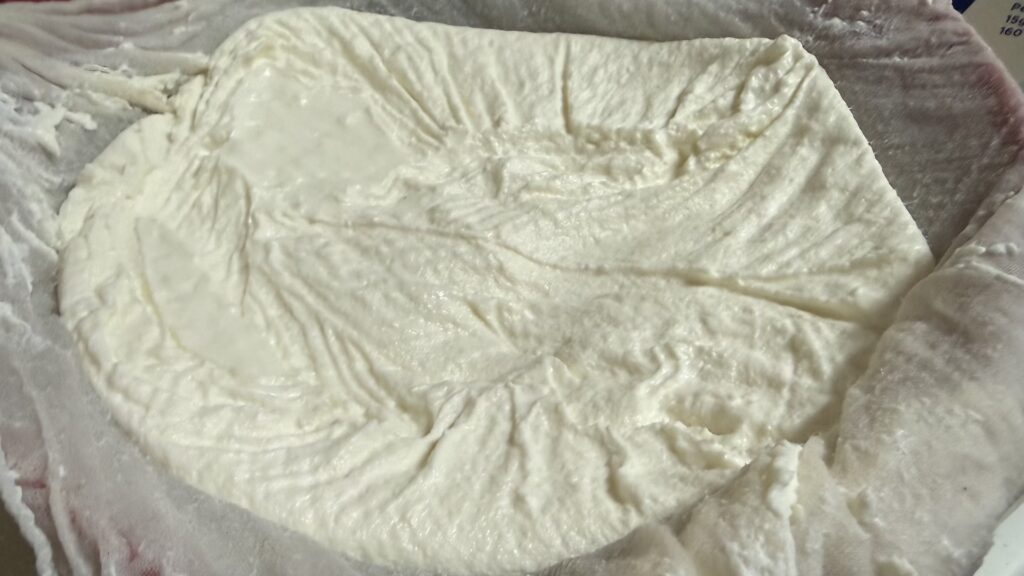
You’ve now made yogurt. Go ahead, open the pot. That liquid is now somewhatish solidified, like Jell-O. But are you really in the mood for that sloppy looking mess? I’ll answer for you: no, you’re not. You want it to have texture. To shimmer under the light, like in the above picture.
So now we enter the second longest phase: letting it get all the gunk out. It’s been traumatized, it’s cooled, it’s been tested for hours… now it’s time to make it uncomfortable once more.
You need a few things: a mesh strainer, a large, deep container (like a pot or large yogurt container), and cheesecloth. If you make as much as I do, you will need a few of each.
What makes Greek yogurt Greek? Well, straining it, like some powerful Ottoman ruler. You want to get rid of everything you don’t want… which is this urine-looking, sticky liquid. Appetizing, right?
You might feel the need to toss it. Don’t. For the Greeks, food waste is a major no-no. That whey still has purpose *cue the cheesy Full House music again*
It is an absolutely perfect ingredient for just about any marinade. I’ve made some of the best chicken souvlaki in the world using that otherwise funky looking liquid. My world, that is. There are some uses. So, grab a jar and save it. The lactic acids in it especially help to break down muscle fibers in meat.
Senses Working Overtime: The Whey of Fundamentalism
I view yogurt whey exactly as I view my upbringing. Okay, maybe I don’t use fundamentalism in a marinade, but I don’t believe it is entirely useless.
Which is where much of my writing now differs drastically from what I wrote two, three, even one year ago. My goal for the longest time was to dispose of all that whey I had to filter out during college.
While I certainly do not embrace fundamentalism, and still wholly despise it, I can recognize its use now. I mean, my wrestling with it took me out of the country twice (and thus, inspired me to make my own yogurt). If not for it, Beyond the Logos would have never existed. And because biblical studies has become such a massive part of my identity, the focus of two degrees, I have enough of a voice to at least confront some issues. On a blog tangled up and hidden in a web of chatbots, AI slop, and politically charged news articles.
I do not make yogurt for the whey. And I did not double-down on my fundamentalism in studying theology. Neither results are the desired end results. They are the excess. They are the byproduct.
And they are useful. Whey makes for an excellent marinade (have I convinced you of this yet?). And I’m with the Greeks on this one: the stuff most people would pour down the drain has a use. It may not be its own star ingredient. Whey soup sounds pretty awful. But combine it with some Greek olive oil, Greek oregano, Greek sea salt… or just olive oil, oregano, and salt… and, to quote legendary actor Carl Weathers, “Baby, you got a [marinade] going.”
The Finished Product: It’s A Sin
And the finished product is a new creation…
Sike!
The finished product is a strained glob of milk and bacteria. It isn’t baptized. It doesn’t come up holier than it was before. No, it comes up contaminated. Literally.
Yogurt is just milk and bacteria. That sentence right there sounds disgusting; but we both know yogurt is not disgusting. There is, of course, good and bad bacteria.
Despite the lengthy process, we have created nothing new. And we have created nothing ex nihilo. All we have currently is what we had before. Milk. Got milk?
I do not want to give you the impression that the process of deconstruction yields a brand new, clean product. It doesn’t. It produces glorified contamination.
Milk, which was once pure and whole, is now contaminated. Contaminated with cultures that thicken it. You probably won’t get that if you leave a carton of milk outside on a hot day. But if you follow the steps I’ve given here…
You have a product that has fed innumerable people four thousands of years. It was once pure; it got contaminated; now, because that contamination was handled with love and care, it’s the best damn thing in the grocery store (I’m a little biased).
One of the reasons I loved visiting Greece, and Greek food especially, is that yogurt is almost always involved. The pastry for breakfast, the tzatziki with lunch, or the yogurt and honey for dessert. It never ends.
If it was marketed as “bacteria induced milk,” nobody would buy it. Slap a fancy label, maybe a mythical country of origin, on it, and you’ve got an essential ingredient. Essential because it stuck through the boiling, the cooling, the heating, and the straining. It made it through. Is it the product it was before? Absolutely not. It’s tainted.
So make sure you’ve got that honey close by.