As I mentioned a few weeks ago, there is wisdom in horror. Sometimes that looks like minding your own business (Jeepers Creepers) or not trespassing (Monster House), other times like not answering calls from unknown callers (Scream), and even still, not getting into a homemade teleportation device without first checking for bugs (the present focus, The Fly). Throwback to my last post: the Instant Pot is a teleportation device for milk; let no flies in.
Happy spooky season! As promised, I wanted to focus a little more on horror films after the thesis adaptation… though I’m a week late. Sorry! I had one day off and a three-hour interview. Needless to say, I’ve felt like Seth Brundle this week. But this post is not a lighthearted reflection. If you’ve ever watched The Fly, then I certainly hope you are not expecting a comforting post. It’s graphic. It’s disturbing, especially for its time. Hope is mostly absent in the film. “Be afraid. Be very afraid.” A very accurate, and very popular, tagline.
I first watched The Fly a few years ago. It isn’t a film I grew up with, like IT (1990) or Pet Sematary (1989). And now, I’ve watched it twice in the last month just to write this post… It’s a brilliant film, ripe with symbolism. And it truly gives an unflinching depiction of both life and death.
The film has been “done to death,” as I often say. As a product of the mid–late 1980s, the film was heavily analyzed as a commentary on AIDS. Its director, David Cronenberg, identifies it as a metaphor for illness, but, most accurately, the aging process. We’re gonna look at it from a different angle; a theological one.
For this post, and the reason I am late with it, I considered analyzing it alongside addiction. That didn’t work. What about deconstruction? I did that last time, with yogurt. Instead, I thought I might look at something I have not addressed yet: AI.
Intelligence Rescues No One
Does Albert Einstein still walk among us? Is Karl Barth still giving lectures? Or, is Martin Luther still nailing theses to the door of the Church in Wittenberg? No. They’re dead. To quote another 80s masterpiece, Dead Poets Society, they’re “fertilizing daffodils.”
The two geniuses under our microscope today are dead. One is a character who dies because his own invention goes haywire. The other is somebody who wrote a book that made it into the Bible without giving a name at all: Qoheleth. A title. “The Teacher.” But you probably know him as the author of Ecclesiastes. Depending on your tradition, you might believe he is Solomon.
One of our protagonists wants to “change the world as we know it.” The other has a book in the book that has changed, or shaped rather, much of the world as we know it. Ecclesiastes is not a very popular book. Genesis narrates creation, the Gospels tell of a messianic figure, Daniel and Revelation discuss the end of the world… and Qoheleth says all is hebel. His book is the book always ready at funerals. “There is a time to be born, and a time to die…”
Qoheleth does not invent a teleportation device. Brundle is not a biblical author. While, as I will argue, the two share some similarities, they are completely different individuals. But my broader question is… what if The Fly is Ecclesiastical?
There is no “happily ever after.” The protagonist seems to pursue wisdom, as well as madness and folly (Ecc. 1:17). The film portrays the progression of an otherwise normal, though awkward, human into a monster causing gruesome violence and mutilation. Can I say this too is hebel?
There are many comparative examples that come to mind. The self-consuming fool (4:5); Brundle’s own device consumes him. “There is a time to be born…” and a time to enter a teleportation pod without first checking for insects. The “royal autobiography” of Ecclesiastes 2, where the author conducts numerous experiments, only to find that everything is hebel.
Brundle’s device may indeed “change the world as we know it,” but he never sees that come to fruition. His work is left to a successor; who knows whether they will be wise or foolish (2:19)?
But I think the real answer comes at the end of the book. “Of making many books there is no end, and much study is a weariness of the flesh” (Ecc. 12:12). Brundle dies by his own smarts. He succeeds in inventing something that would indeed change the world as we know it. But, in that process, he becomes a victim of that very device. His life’s work, his greatest invention, costs him everything.
And he hardly seems to realize that as he descends into madness.
When the Goldblum… Isn’t the Goldblum
Jeff Goldblum. I assume we all know him as Dr. Ian Malcolm, from Jurassic Park, the most unnecessary character in any popular movie. A guy who is just there to offer technical wisdom: “Life finds a way.” What does a mathematician have to do with dinosaurs? Chaos theory my ass.
But in the 1990s, Jeff Goldblum was a sex symbol. Even now, he’s much more attractive than the guy writing this. Someone who made glasses sexy. His performances in The Fly and Jurassic Park solidified this.
I don’t know why The Fly is in there. He plays a nerdy, insecure scientist. And that’s before he mutates himself. He seems quite desperate to impress this Veronica, with his device that will “change the world.” As she admits in the first scene, he probably “doesn’t get out much.”
But not all sex icons are always sexy. Sometimes, they are humanoid flies. Literally. That’s what happens to “the Goldblum.” He becomes an insect. A violent one, at that. He’s very much eccentric, at the very least. Elvis Presley hasn’t ever really been a nerd, I don’t think. Definitely not an insect. Then again, I’m sure there’s a conspiracy theory out there for that.
The Goldblum has. He has been a fly. There was a time, though brief, where the Goldblum was anything but sexy. Even if it’s just the last hour of one film. If you think a nerd can be sexy, you have a lovely heart. If you think an insect is sexy… you need help.
I doubt Qoheleth was a sex icon, but he made enough of an impression to get into the canon… somehow. Whereas other biblical authors speak of God creating the world, and others God walking among men, still others God punishing nations… Qoheleth just tells us that it all sucks.
It’s all hebel. He’s done the research, and he’s ready to show us. Will it change the world as we know it? I doubt that was his intention. But I do believe it at least gave voice to those who think, “You know what? This really does suck.”
No, everything has not been spliced with a bug. But nothing is the way it should be, whatever that even looks like. Nothing makes sense. And trying to get to the bottom of, or change that, is quite costly.
Theology of The Fly: The Quest for Knowledge is Deadly
I feel like we all have this idea that the more knowledge you have, the more successful you are. Less likely to die in bizarre ways. Smart with your money. Wise with your wisdom. Just in your judgment. And those things may be true in some cases. But we all know the expression “too much of a good thing is a bad thing.”
Brundle is a total genius. He built a teleportation device. I don’t think that’s been done in real life, even in the 40 years after the film.
I think of my time in Boy Scouts. Part of the Electricity Merit Badge requires one to build two functional electrical projects. My favorite is the basic closed circuit. In a nutshell, you connect a light to a battery via electrical wires. It’s my favorite because I’m the one who made fire. But hey, that counts as light, right?
Several years later, in a short-lived maintenance role, I took out power to an entire building. Inventing was never for me.
So, I have a lot of admiration for Brundle’s ingenuity. It’s perhaps debatable whether his invention is truly successful. I think it is. One item is teleported. Living beings are teleported. There’s just a margin of error that cannot be brushed off. Or swatted away.
The device, his invention, the product of his knowledge, is contaminated. His life’s work. He succeeds in his empirical quest, but at the expense of everything else. Everything that means anything to him.
That reminds me of one of my favorite passages: “For in much wisdom is much vexation, and those who increase knowledge increase sorrow” (Ecc. 1:18).
This is not a call to be ignorant. Qoheleth has much to say about folly, too. He wouldn’t tell you to be Homer Simpson. Ecclesiastes 1:18 is a call to be careful. Like attaining wealth, health, or anything else, knowledge comes with risks.
Brundle invents something that will “change the world as we know it.” The way for his knowledge to increase is for him to no longer be human. And that is exactly what happens. Though his smarts allowed him to build a teleportation device, they do not seem to have him checking for foreign objects.
In his pursuit of knowledge, he goes through. And when he comes out, he looks the same. Then insect hairs start growing out of his back.
A Side… Character?
There aren’t many characters to keep up with in The Fly. The protagonist, the lover, the lover’s-manipulative-cocky-ex-who-ends-up-being-some-kind-of-hero, and a small handful of other side characters. And of all those extras, the one I’m concerned with is not portrayed by a human. It is a computer.
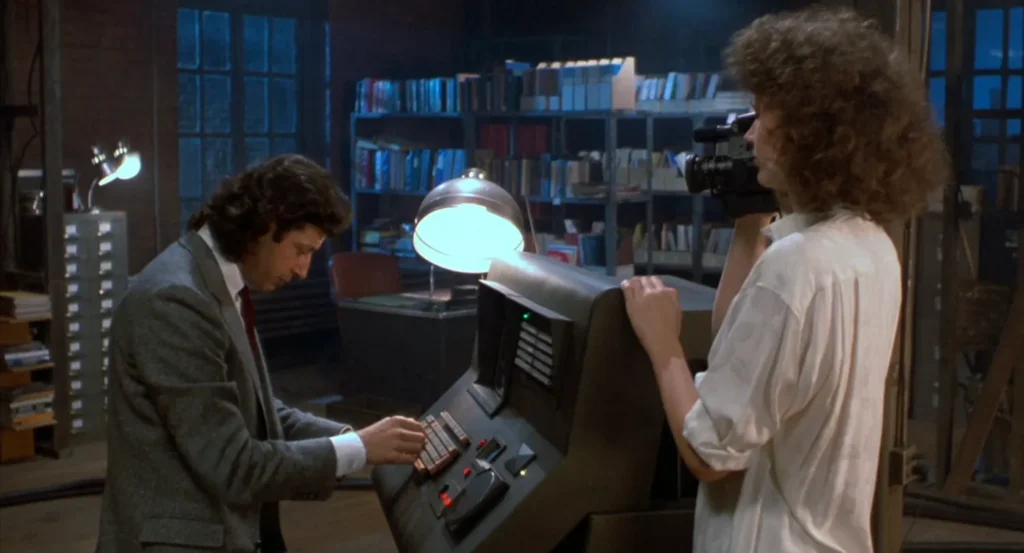
Yes, the computer. The device that decides what happens to its user. Sounds a lot like a modern tool we’ve heard way too much about, does it not? Where does Brundle get his revelation? From a side character who only gets a role as long as Windows isn’t down.
When Brundle is in crisis, by this point halfway to his final form as a fly, the computer decides what is best. How can Brundle return to form, as if nothing ever happened at all? By splicing himself with another, pure human being.
In order to be healed, a sacrifice is necessary. And it’s Jesus.
Sike!
It is another living and breathing human being. Because Brundle has managed to completely contaminate the only life he had, his own, he now needs the sacrifice of someone not so foolish to heal him. The computer does not volunteer itself. It volunteers another, though innocent, human being.
Let’s cut to the chase. How many people use AI as a therapist? Or as a friend? As someone who can help them out of the mess they’ve created? Who must ask ChatGPT before making a decision?
There is no shade here. The point here is not to fault the human making that exact decision, it is to fault the machine. The idea of a sentient-though-inanimate object offering life advice is not new. Prophetic messages, oracles, crystal balls, even dice. Human history is full of attempts to create a device that can solve its creator’s problems. And now, in 2026, we have it.
It’s called ChatGPT. Gemini. Claude. The awkward newcomer that will likely be exterminated or renamed, Muse. Copilot. The list goes on.
And they all do the same job as Brundle’s device:
Help! I’ve made a mistake. What’s the best way to get out of this rut I’ve got myself in?
Answer:
You are absolutely right! There is no reason a well-mannered, caring individual like yourself should have to get yourself out of such tragic situations. While some may say you should climb, the scientifically proven method is to stack whatever objects you have available. It’s not about climbing—it’s about stacking.
That’s a far-fetched—but let’s face it, accurate—depiction of what we’re dealing with here.
When even Brundle himself can admit he’s becoming a fly, an insect, vermin, he still relies on the technology to help him out. The computer, with no human emotion, suggests an idea for attaining humanness that requires the sacrifice of an entire human being. Something the technology cannot understand.
And something the protagonist cannot seem to understand either. So, he trusts the technology anyway. So what if it means unveiling his true insect form? That was always there. It just took pulling some teeth to get there (pun absolutely intended, if you’ve seen the film).
In the final act, Brundle attempts to splice himself with his partner to return to purity. That costs him his life, Veronica her emotions, and her ex-turned-questionable-hero a foot and a hand. A foot and a hand lost to corrosive insect fluid, at that.
In his final form, Brundle becomes part man, part insect, part machine. And in that form, his only remaining request is for Veronica to end the monster he has become. He has become one with the fly. He has become one with the computer, the AI.
The Fly didn’t predict AI. But it’s an accurate, though dated, parable. The computer cannot check for foreign objects. Only Brundle can. But he treats the computer as if it can do all because it can analyze all.
In much wisdom is much vexation, and an increase in knowledge means an increase in sorrow. And there is a lot of knowledge in AI. Meaning there is much sorrow to be had.
We’re in an age where it is very easy to become Seth Brundle. It is very easy to become the Fly. Just because the machine can solve for x does not mean it can perform human tasks.
You still have to check for that fly.