
So, my thesis is that Qoheleth deploys the term hebel as a protest against faulty theologies and the reality of the deliberate God. The God who is hidden. Qoheleth is, then, just a darned rebel, right? Perhaps, if you are a fundamentalist.
While there is much that differentiates Qoheleth from other authors of the Hebrew Bible, there is, indeed, some overlap. Such as a God who hides. Isaiah 45:15 (NRSVue) says, “Truly, you are a God who hides himself.” That sounds pretty final to me.
The question is not whether divine hiddenness is foreign to or incompatible with the Hebrew Bible. It is how Qoheleth shapes such a theology. And, of course, the inevitable question of how that hiddenness relates to the moral intelligibility of life “under the sun.”
The Ship of Theseus
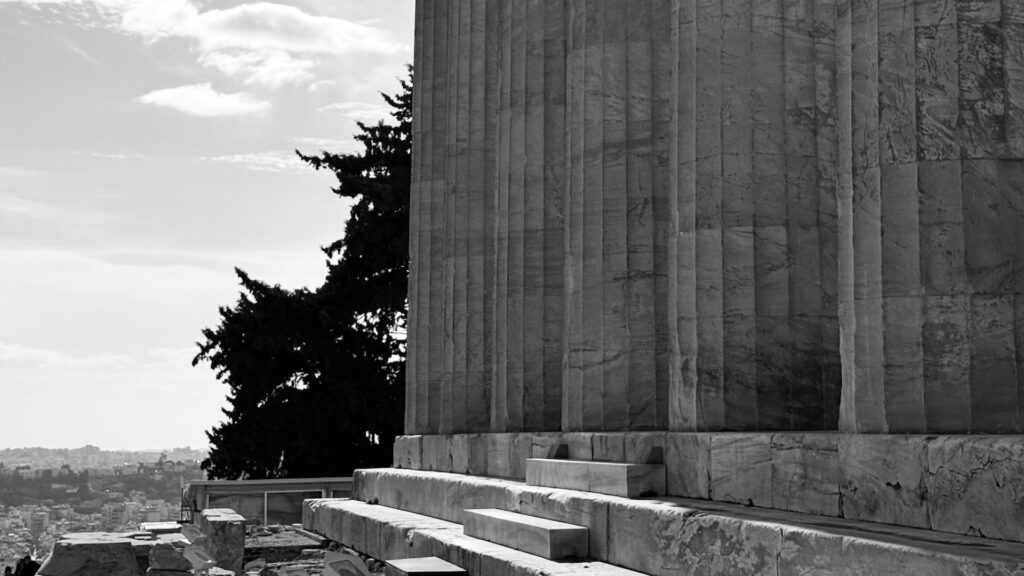
Throughout this series, all the photos I have used were taken during a travel seminar to Greece in my final semester. As such, I would be remiss if I did not include one example from Greek mythology. It is not in the original thesis.
In Greek mythology, King Theseus of Athens rescued the Athenian youths from the Minotaur on Crete. During the return voyage, they stopped at Delos before sailing home to Athens. The Athenians preserved the vessel and reportedly sailed it to Delos each year in commemoration. But of course…
Parts must be replaced. A wooden ship, like the Ship of Theseus, has planks that deteriorate over time and must be replaced. Eventually, all the planks were replaced… leading to the popular paradox: is it still the same ship?
Across the Hebrew Bible, God’s relational proximity to humanity gradually recedes, as Mark McEntire observes in Portraits of a Mature God. God goes from walking in the cool of the evening in the garden to not being mentioned once in Esther. Is it still the same God?
Even in Exodus, the Israelites beg Aaron, in Moses’ absence, to give them a god (or gods) “who shall go before us” (Ex. 32:1). So what do they do? Aaron constructs a golden calf and they begin worshipping it. Yeah, after providing manna and water in the wilderness, I might ghost someone like that, too.
Centuries later, Amos portrays God as still intervening (albeit through famine, drought, blight, plague, and destruction) only for each intervention to end with “yet you did not return to me, says the Lord” (Amos 4:6, 8, 9, 10, 11). God repeatedly acts, but the people repeatedly fail to return. By this point, perhaps only a few centuries before Qoheleth, God was pissed.
Across these traditions, the divine-human relationship—and the theologies built around it—stands in constant need of repair. God has tried to repair it; humanity has not. The theologies are in constant need of repair. For Qoheleth, in my view, the planks are nearly gone. But somehow, the divine ship remains.
Qoheleth Replaces a Few Planks
Earlier in the Hebrew Bible, the Deuteronomist describes God as being “in heaven above and on earth beneath” (Deut. 4:39). In Ecclesiastes, Qoheleth inserts an “and you” before the “on.” God is in heaven, and you are on earth. It is quite clear that God is in an entirely different realm, separate from humanity.
Even God’s name. I try not to rely on this much, as it is far from the strongest argument. But it is worth noting. Many know that God has a few different names in the Hebrew Bible. YHWH, el Shaddai, Adonai, Elohim, etc. And of course, the first of that bunch is the most popular. It is also the more intimate name for God.
And Qoheleth never uses it. Not once. God is addressed solely as Elohim, a less personal name for God. However, just because Elohim is used and not YHWH does not alone qualify a case for divine hiddenness or absence. The cherry on top, perhaps?
The problem with total absence is that God still acts. God has acted, acts currently, and will act in the future. Yet, the same God renders such actions illegible to humans. The environment is thus divinely ordered obscurity. And of course, hebel serves as the literary-theological verdict. Life under a God who cannot be seen, whose actions cannot be felt, and whose governance grants no room for stable moral intelligibility “under the sun” is, likewise, hebel.
There is no “grand finale,” like there is in Job. Job at least gets to confront God. What does Qoheleth get? Hebel, and a chasing after wind. As he tells us repeatedly, the world is absurd and futile. Like with a defective product, we begin to wonder: who manufactured this garbage? Is Qoheleth doing something similar?
Perhaps.
No Comforter, No Friend
Having a relationship with God is a staple of the Abrahamic religions. Especially American Christianity. When I was a child in children’s church, I remember singing this cheesefest of a song: “I am a friend of God, I am a friend of God, he calls me friend.” Such a relationship was absolutely essential in my former traditions.
For some, myself included, it is impossible to have such a relationship with God in Ecclesiastes. As Luca Mazzinghi, President of the Società Biblica in Italia, notes, because Qoheleth’s God is absolute in sovereignty, humanity is locked out of personal intimacy with the deity.
God has kept you from understanding certain things. God has made humans search for answers and wisdom, “an unhappy business that God has given to humans to be busy with.” Who sits atop the hierarchy of corruption and oppression (5:8)? How is it that the oppressed have no one to comfort them, and as such it is better to be dead or nonexistent? God has prevented humans from enjoying things such as wealth, possessions and honor, which is not just hebel but also a grievous ill. And, of course, you must guard your steps and limit your words if and when you do approach this God.
“I am a friend of God”… but most definitely not that God.
You can be a faithful servant, maybe, but you cannot have anything resembling personal intimacy with such a God. God oversees human “evil work.” But worse than allowing evil to triumph under the sun, this God withholds any comforting presence that might traditionally be a hallmark of divine governance. There is no covenant here; only a forwarded contract.
Theodicy Without an Answer
Qoheleth’s theology of absence is not a pithy example of human frailty, but what Qoheleth finds to be the nature of divine operation. Theodicies often relate to an assumption that suffering arises from misinterpretation or an incomplete vision.
For instance, Isaiah 40:1 proclaims God as a comforting presence, commanding Israel, “Comfort, comfort my people.” But in 49:14 (erroneously 49:12 in my thesis… oops), Zion says, “The Lord has forsaken me, the Lord has forgotten me.” Zion interprets divine absence as abandonment.
Or, better yet, Job’s friends. They assert the fundamental theodicy, that Job has sinned and is presently being punished by God. Yet, in their view, Job either refuses to admit any wrongdoing or perhaps can’t remember what he did wrong. His suffering is exacerbated by such an incomplete vision.
Qoheleth’s theodicy is even more unsettling: God actively prohibits humans from understanding (3:11; 8:17). Which, of course, must include their understanding of their own pain. Combine that divinely engineered obscurity with the realities of injustice, and the protest relates less to misperception and more to intentional moral incoherence in God’s creation.
Unlike most popular examples of God’s power in the Bible, God’s power in Ecclesiastes is reflected through withdrawal and withholding. By design, reality is not just difficult to grasp, but actively obscured by its Creator to manufacture a boundary with humans.
Hebel as Protest
Hebel functions as a protest by naming the consequence of living under divinely maintained opacity. Throughout the book, Qoheleth repeatedly identifies that which is incoherent and expresses strong existential frustration through hebel. And that becomes a protest.
It becomes a protest because it is a refusal to accept the reality of a world where understanding is intentionally thwarted, and the Creator of it all remains hebel. That which is hebel is hebel precisely because it is not the way it should be. It, as I argue, “acknowledges the utter incoherence of life under the sun and seeks to name a sovereign God who stays outside the reach of rational theodicy and moral verification.”
In Qoheleth’s theodic crisis, God is at the very center of the hebel paradox. His protest is not that suffering exists. Booooring. No, his protest is against a divine governance, or lack thereof, that allows such realities to define life under the sun.
He refuses to harmonize the “ethical incoherence of God’s work,” according to Antoon Schoors. The theodicies of his day aren’t holding up. Reality does not reflect divine providence, care, or especially comfort. And that is absurd. It is vanity. It is futile. Pointless. Meaningless. A chasing after wind and an unhappy business.
The Never-Ending Mystery
But what is distinctive about Qoheleth’s protest is its indirectness. Unlike some others in the Bible, he does not directly accuse or curse God. He does not portray God as some malicious torturer. But this God is also not the God who walks in the cool of the evening.
This God can get angry and destroy works. But above all else, this God is hidden and inscrutable. Those are the defining characteristics. That is not exactly a comforting thought.
What is worse is a misconception. A misconception that God will provide comfort when there are people defined solely by their victimization and tears. A misconception that humans can have a personal relationship with this deity who is entirely sovereign, who withholds knowledge to preserve fear. This is what it looks like when the raw reality of human pain and suffering collides with traditional affirmations of divine care and justice.