
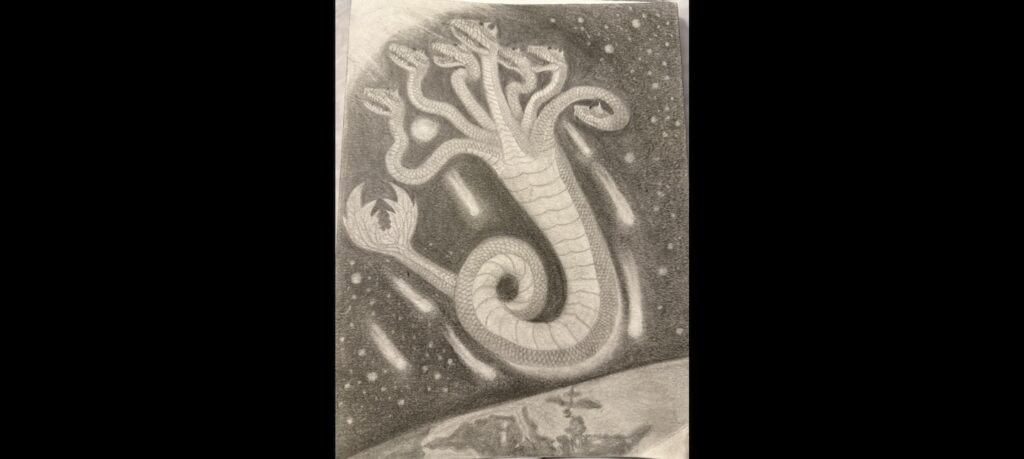
This is not a traditional Beyond the Logos post. It is more of a laid-back “treat,” I guess. I do not use a lot of visual media often here, but for this one, it is necessary.
Acknowledgment
This piece, both the drawing and the post itself, is dedicated to the person who helped me graduate: my professor, advisor, and secondary reader on my thesis, Dr. Susan E. Hylen. The drawing, a depiction of Revelation 12:9, was completed as an assignment for her class, Revelation and Its Interpreters.
Dr. Hylen agreed to be my advisor in October 2024. The following week, on Halloween, I showed up to her class dressed as Art the Clown, from the Terrifier franchise, a horror franchise notorious for its graphic violence. I find this detail exceptionally notable here.
Susan Hylen is the Charles Howard Candler Professor of New Testament and Director of the Women, Theology, and Ministry Program at Emory University’s Candler School of Theology. Hylen is also the general editor of the Journal of Biblical Literature, the premier scholarly journal in biblical studies. And to this graduate, she is both a blessing and a life-changer.
Introduction
As a lifelong student of the Bible, Revelation has always been one of the most fascinating books to me. I do not think one must be religious, or even familiar with the Bible, to appreciate the literary artistry of John of Patmos’ vision. That said, the book is dense. And it is hard to imagine seven-headed dragons, seemingly crossbred monsters, and the hero of it all being a lamb.
But I have always held an especially deep fascination with the character of Satan. I have found the character’s development quite magnificent: from a heavenly council member in Job who carries out God’s dirty work, to a grotesque beast responsible for all calamity, to, whenever we got this, a red-haired goatman with a pitchfork.
The depiction in Revelation, though, especially stands out to me. All of the beasts in Revelation are hard to fathom, but I wanted to focus closely on him. I have always struggled with conceptualizing a seven-headed dragon with ten horns and seven diadems. Are all the horns on one head? Are some heads more horned than others? How do we imagine this beast, and then imagine it being cast from heaven and eventually defeated?
“Then another portent appeared in heaven: a great red dragon, with seven heads and ten horns and seven diadems on his heads. His tail swept down a third of the stars of heaven and threw them to the earth…The great dragon was thrown down, that ancient serpent, who is called the devil and Satan, the deceiver of the whole world — he was thrown down to the earth, and his angels were thrown down with him.” ~Revelation 12:3–4, 9, NRSVue.
One Last Hoorah
In my very final assignment at Candler School of Theology, I had the option of creating an artistic representation of something from Revelation. The scene that stood out to me is contained in Revelation 12. I wanted to capture Satan being cast down from heaven, following the great battle in heaven in Revelation 12:1–9.
The guiding question for me, at least initially, was: how on earth did we get here? From someone who tests people for God to a beast who is the destroyer of worlds?
But given my research on suffering and theodicy, that question changed pretty rapidly. It became: is John trying to convey something about suffering? Is this what his audience may have imagined?
Cloverfield: A Contemporary Case Study
9/11 changed everything, and that is a fact. Post-9/11 films especially mirror this phenomenon. Specifically, my two favorite genres, horror and comedy, underwent tremendous changes. In the face of such a tragedy, horror movies became much more violent. Compare The Silence of the Lambs or A Nightmare on Elm Street with Wrong Turn, Saw, and Hostel. On-screen blood and guts became much more prevalent — and graphic — than they had ever been. That period, 2001–2010, brought “torture porn” to fame.
I believe the film Cloverfield is an especially notable example of this. The film is often interpreted as a metaphor of the 9/11 attacks. A beast from outer space destroys New York City. That’s a hard metaphor to miss. It is meant to capture the anxiety of a grieving world. There is no resolve for the victims. And Clover is a much more frightening and relentless creature than, say, the shark from Jaws or Godzilla. In that sense, the monster does what monsters often do: it gives terror a body.
Who the hell would want to watch such mayhem for pleasure?
As a kid at the time, I remember being horrified and concerned by how my siblings would watch these things. My mother was very much anti-horror. The only horror movies allowed in our home were Signs, Jaws, and Jurassic Park. That said, I was still exposed to Final Destination and Jeepers Creepers. Which I am now grateful for.
As a child, I never understood why people would watch such things. But by middle school, I was a devout horror fan. It seems the older I got, the more I enjoyed the violence.
It was also my grief. As I faced that monster, suddenly, I needed something I could relate it to. And for me, that became gritty films with no resolution. I could only see my grief as Art the Clown, or the nuclear war of Threads. Perhaps Clover, a monster hardly seen, but knowingly fierce and unrelenting. Those cinematic elements did not provide me “hope.” They provided me something I could relate to.
Grief is a word that gets used so much that it can sometimes skip over the grieving process. Evil does not sound as strong as heinous or depraved. The terms get used so often, so prevalently, that they lose their radical edge.
We need words that more strongly convey our emotions. But sometimes, words strung together do not work. Sometimes it takes a, dare I say, heinous description. A metaphor.
Do the Beasts Represent Something?
I am not qualified enough to argue what exactly the beasts represent. I believe the beasts of Revelation 13 perhaps represent the Roman Empire and/or persecution, but again, I do not wish to make any underdeveloped claims as fact. Regardless, it is clear that these beasts represent something. There is an emphasis on authority and persecution.
However, Satan is, at least from where I’m standing, a bit easier to interpret. By this point in theological history, Satan is no longer merely an accuser working with and for God, as in Job. Satan has tempted Jesus in the wilderness (Matt. 4:1–11; Luke 4:1–13). The Book of Enoch, before the Gospels, has illustrated fallen angels. Satan is becoming almost indistinguishable from figures like Thanatos or Hades. He is becoming a villain.
And in Revelation, Satan is indeed the villain. That ancient serpent (12:9). John’s Apocalypse gives us the final biblical form of the character. But he is grotesque. He is a giant, winged, seven-headed dinosaur that roars loudly and breathes fire… except that is not exactly right.
Here Be Dragons
When I hear the word “dragon,” I think of two specific conceptions.
The first, on a lighter note, is the Beast of the Castle of Aaargh in Monty Python and the Holy Grail. A dinosaur-like creature, intentionally exaggerated with many eyes. It makes the killer rabbit look… well, still terrifying with its “big pointy teeth.”
The second comes from a lesser-known work, The Oath by Christian novelist Frank E. Peretti. Peretti is… wait for it… a Christian horror author. And indeed, I cherish some of those books. I could not read Stephen King, but I did have Frank Peretti. I would highly recommend The Oath and, my personal favorite, Monster.
Yet, I still regard The Oath highly, though it has been well over a decade since I read it. But as I recall, the dragon is a manifestation of unrepented sins. The dragon possesses distinct limbs, wings, and fire-breathing abilities, aligning much more closely with medieval depictions. I believe the dragon also grows the more the townsfolk continue to sin. Prophetic.
But this is not what John had in mind. Dragons have existed for several millennia and across cultures. And so, in order to do an artistic representation, I figured I would consult some ancient depictions of dragons.
For the ancient Greeks, dragons (δράκοντες; drakontes) were essentially massive snakes. But instead of just telling you what snakes are, I want to show you some of the sources I referenced.
House of the Dragon
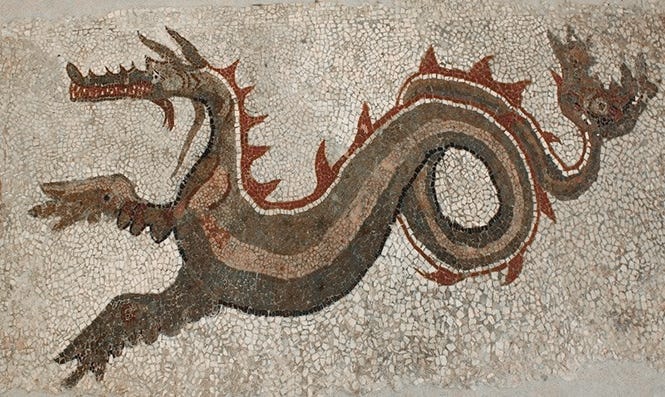
Let’s start with a tail. Now, snake tails are literally the smallest part of the animal. But according to Revelation 12:4, the dragon’s tail sweeps down a third of the stars of heaven and throws them to the earth below.
An ordinary snake tail does not seem capable of doing this. As such, the tail in my representation is based on a mosaic from the House of the Dragon. This unique depiction is a third-century polychrome mosaic discovered at the ancient Greek site of Kaulonia, in what is now Southern Calabria in Magna Graecia, Italy.
As you can see, this “large snake” has some interesting features. It has what appear to be arms or wings. Its tail is large. Its head, in my opinion, resembles more of the East Asian depictions. Finally, like John’s dragon, it has two horns.
Drakon Kholkikos
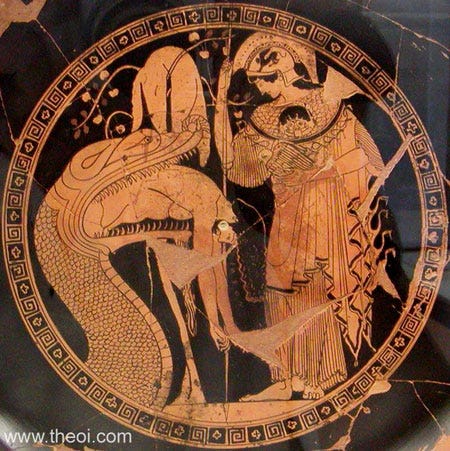
For the head, my primary source of interpretation comes from the Drakon Kholkikos, or Colchian Dragon. Now, I must clarify: I was inspired by the elongated head and the many teeth. In Greek mythology, Jason is connected to the dragon’s teeth tradition, in which dragon’s teeth are sown into the ground and armed warriors spring up from them.
The Ismenian Dragon
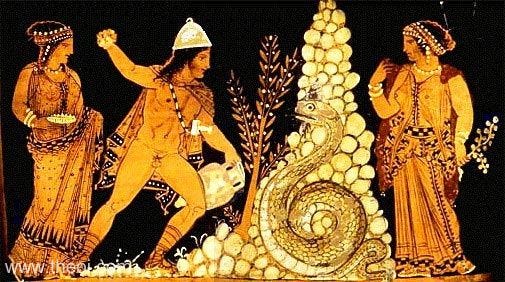
Perhaps least significantly, I used this depiction in approaching the scales, which, I admit, was the absolute most painful part of this project. I abused my eraser trying to mimic this and still could not quite get it. As you can see in this depiction, the scales are extremely rounded.
The Lernaean Hydra
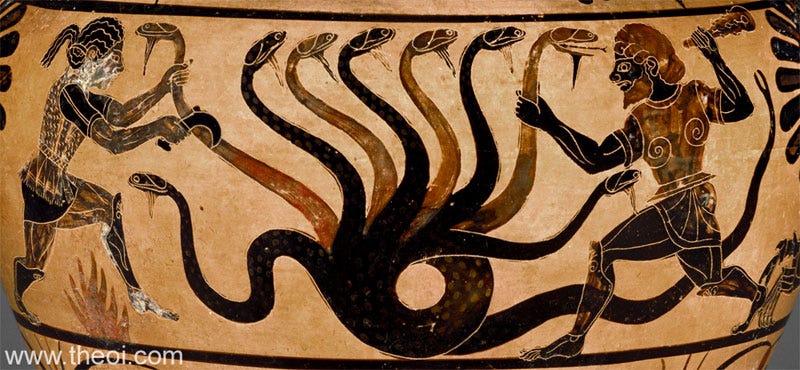
Finally, the Hydra. I find this an especially noteworthy reference for thinking about John’s Apocalypse. This infamous beast is a serpentine lake monster with several heads, the exact number often varying. Later versions of the narrative propose that each time a head was cut off, another grew. It was a vicious, ugly beast. And I cannot help but believe John of Patmos knew the imaginative power of this kind of monster and used it as a way to communicate how grotesque Satan is.
Why Is Satan Grotesque?
So, in conclusion: why is Satan grotesque? Satan represents evil and suffering. From my theodical perspective, that is the case. Suffering is bad; suffering is evil. Suffering and evil are both… heinous. And they deserve to be represented as such.
This, in my view, is the message John wanted to convey in Revelation 12:3–4 and 12:9. Satan represents all the pain and suffering in this world. John needed to represent this accurately. And so, he identified what his culture was afraid of: multi-headed dragons.
As films like Cloverfield, Wolf Creek, and Final Destination addressed foreign intervention, terrorist attacks, random death, and worldwide anxiety in graphic, contemporary ways, so did John address the topics of his age in the most graphic, unsettling ways he could. That is how you convey a message.
Postscript: Earth Below
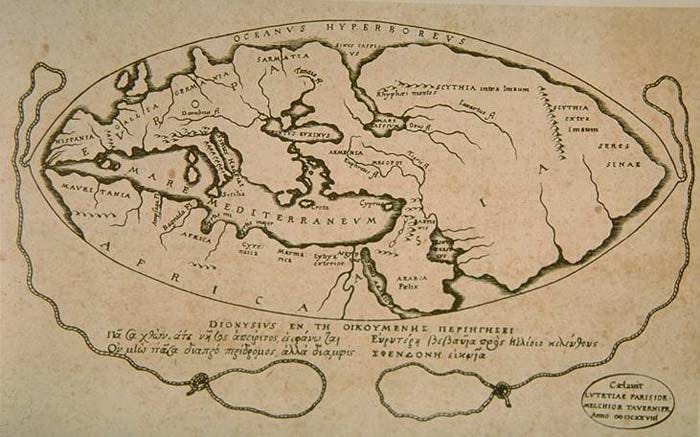
Initially, in the drawing, I did not plan to include details of earth. Perhaps just the atmosphere and nothing more. But surely by this point, John and his audience had some conception of what the world looked like. And so I based “earth below” on a map reconstructed from the geographical ideas of Posidonius, a Greek philosopher, politician, and geographer.
Is it not obvious? Greece is tremendously larger than other visible nations, such as Italy.
Having visited Greece, however, I can understand that inflated conception. It is the most gorgeous place I have ever seen. And while it may seem silly to a twenty-first-century American with Apple Maps easily accessible, to an audience two thousand years ago, this may have been what the world looked like.
May have been, because nothing in this interpretation can be proven. But it is, indeed, based upon what archaeology and ancient imagination have given us.