
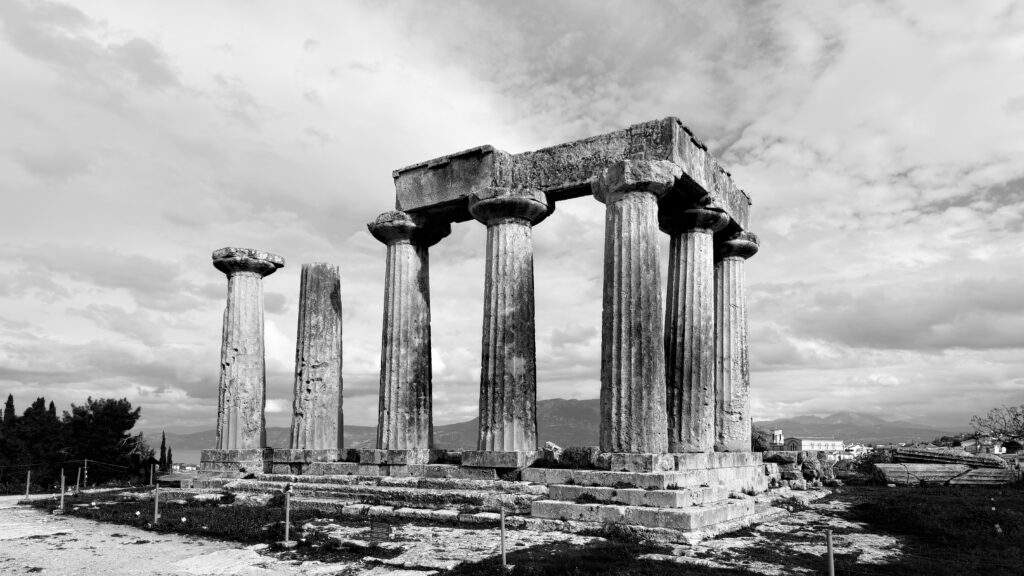
“Qoheleth expresses this dissent through a fragmented faith that dares to voice the incoherence of suffering without seeking a premature or facile resolution.”
Life is absurd. And life sucks. But why? Perhaps because humans are just awful. AI is even worse. But it still sucked before AI. It sucked in 2020, and it sucked before the common era—or Christ, whichever you prefer.
For Qoheleth, the reason why life sucks is—of course—unorthodox. Because God has made it so. God has provided for humanity, but God has also made divine action indiscernible to humankind (Ecc. 3:11). Because divine action is obscure, Qoheleth concludes that God is hidden.
Put yourself in that frame of mind for a moment. You know for a fact that God is real. And then you turn your gaze to the state of the world. You see people suffer with no one to comfort them. You see the absolute depths of pain and sorrow, with no one to wipe away their tears. Of course, you see the wicked prevailing and the righteous constantly pushed around.
In your heart, you say this should not be so. And when you seek out God, you do not find God. Maybe some signs, like a number or an oddly shaped cloud. But does God respond to your calls? Or even texts?
A Personal Reflection
As a child, still religious at the time, it always amazed me to hear people say God spoke to them. Really?! Because when I cried out, I never got a response. Maybe the church folk were right… maybe my mind wasn’t in the right place to discern divine communication.
The absolute worst of it was when my mother was sick. I was deeply religious then. And I begged God constantly for a sign, a message, something. Eight years ago right now, I was begging God for some kind of communication. Enough to push me into studying theology, as if that might speed up the process. It didn’t, I can admit now.
God was not speaking to me. I knew in my heart that God was real; at the time, nobody could convince me out of my belief in God. But I could never find God.
Unlike Qoheleth, that failure to find led me to renouncing my faith. Eventually, only like four whole years later. I never “found” God. But God was not just hidden, God was completely absent, in my estimation.
So God spoke to my friends. But never to me. Matthew 7:7: “seek and ye shall find.” That did not hold up for me. It still does not.
And the crazy thing is? I believe Qoheleth and I have that in common. We both searched for God, only to find nothing. But Qoheleth was one step ahead of me—because you cannot find God does not mean God is nonexistent, or will never be found. For him, God is playing hide and seek.
Just, the only rule is… no peeking. But of course, God is peeking when you go to hide. God is God, and is therefore always peeking.
The Search
The worst part of it all… the search. Qoheleth documents his search. Everywhere he looks, he sees injustices, absurdities, and pain, before issuing his indictment upon life and all that is within: all is hebel. He juxtaposes the realities of life, such as the oppressed without comfort, with the painful reality of a God who is both distant and inscrutable.
He looks at the value of friendship (4:9–12). Ointments, birthdays, and death days (7:1). Even the wind blowing round and round (1:5). And of course, the bad things. Oppression, injustice, unreliable hierarchies, and the like. His conclusion? It’s all hebel.
What hebel means—and I mean this honestly—may never be known. But he issues that judgment. It’s hebel. As far as a meaning, the best we can come up with is vanity (NRSVue), meaninglessness (NIV), pointless (CEB, CJB), or futility (NET). It is clear that it’s not good. Is it all awful? No, not necessarily.
But it is not the way it should be. In our minds, we believe that if we do a good deed, we will be rewarded. But when we aren’t? It’s hebel. Inscrutable. It does not make sense.
Such is the quest for the meaning of life. One can never know because God has prevented such understanding. The final chapter exists, but, at least in this lifetime, we are completely incapable of reading or grasping it.
And that, too, is hebel.
A Refusal to Bend the Knee
Why Ecclesiastes? Why Qoheleth? Whenever I discuss my research, this question will surely come up. And my answer is, in Qoheleth fashion, “I don’t know.” I will address the real “why” more thoroughly later.
But for right now, there is something I want to acknowledge, and that is that Qoheleth never relents. Not once does he say, “Okay, Deuteronomy, you are right! God is both in heaven and on earth.” Or better yet, “Okay, Isaiah, I agree with you, bro: God comforts us.”
Yet instead, we are told God is in heaven and you upon earth. Yet instead, we meet the oppressed, defined solely by their tears and victimization. Qoheleth KNOWS his scriptures. He may not cite them like a modern commentator. There probably were no footnotes in the first copy of Ecclesiastes. Yet, Qoheleth possesses some kind of faith. He still believes in God and never relents in that regard.
But having faith and sanitizing every word you speak are not the same. One of the things that made me tick as a churchgoer was the praise and worship team sneaking up to the stage during the post-sermon prayer. Pastor makes an evocative statement—like “God bless our veterans”—and suddenly—cue the lights! We are getting piano chords in the background. A real tearjerker. Amen, amen, and amen.
I imagine Qoheleth would vomit at the sight. Or sound, rather. Being reverent is not the same as offering pithy prayers to piano keys. Sometimes, being reverent requires one to protest. Even if that is against the one who created it all.
The Result
We can save the heartfelt worship for later. The Epicurean debates on evil and suffering can wait. What cannot wait is the acknowledgement that sometimes, life sucks. Sometimes, life is meaningless, or pointless, or futile. We expect divine order. And, at least in the case of Qoheleth, we find absence.
We find a chaotic world that serves as the analogue of a silent deity in heaven. The oppressed without comfort? The endless “toil” that defines life? Or, how about the cancer diagnosis? The ill veteran who cannot afford insurance and is ridiculed by a younger generation? Those born into addiction, without any chance of avoiding their genetic predicament?
The world sucks. Everything sucks. I am goth, and that is my philosophy. I see the glass as 52% empty, not half empty, and definitely not half-full. And that philosophy comes from theology, particularly that of Ecclesiastes. It comes from one person, so troubled by pain, that he wrote one of the most beautiful literary works in the entirety of human existence.
Unfinalized. That is how I approach Ecclesiastes. Unfinalized because it was true then, it is true now, and it will remain true in the time to come.
I have no “apology” to make. The world sucks. Life sucks. I do not feel the need to defend such claims; you already know. Sometimes, things are just awful. Sometimes, everything just fucking sucks. And sometimes, the direct cause is the entity we praise daily.
God flooded the earth in Genesis. God destroys nations in Amos. The same God the church down the road praises every Sunday… that very same God has bloody hands. For Qoheleth, we cannot see those hands. But, just because we cannot see one thing does not mean that our first guess was wrong. The world God designed is absurd. It is vanity. It is an endless striving after wind, an unhappy business, and above all else, it is hebel.