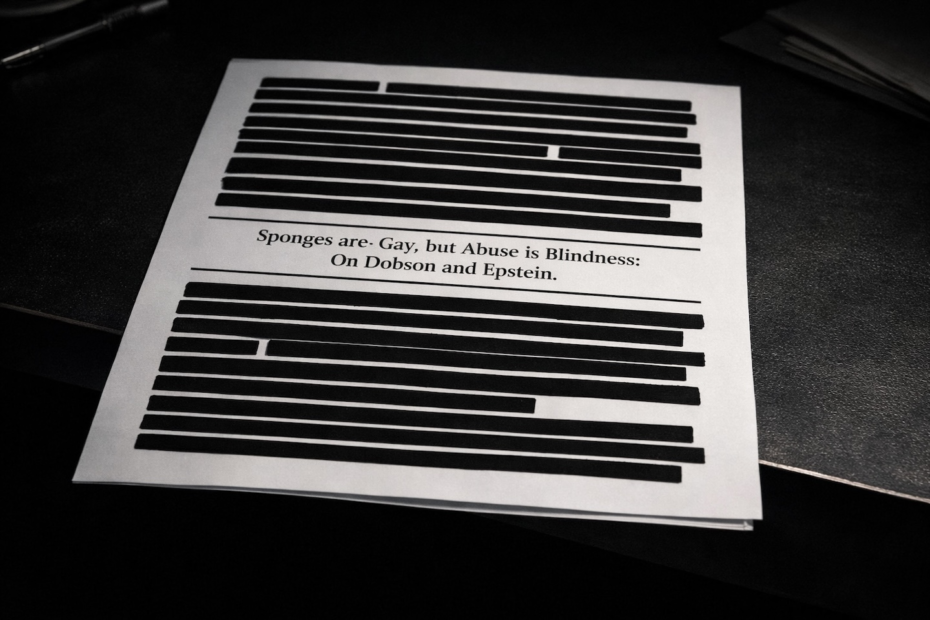
Imagine getting rich by telling people you champion “family values” and religiosity, only to have your entire public “calling” shaped by homophobia and misogyny. Plus, he was beloved by Jeffrey Epstein himself. Sadly, the person this post is about is a modern saint in some evangelical circles. I am talking, in this case, about Dr. James Dobson.
I admittedly carry a bias into this post. My mother loved Dobson. As a conservative, homeschooling mom, Dobson was the perfect resource for teaching what would otherwise be “secular” topics. You know… sex. Mostly that. As the child, I never exactly liked him. Especially not today.
Dobson—thankfully not a real theologian—famously went on a literal tirade about SpongeBob SquarePants promoting homosexuality because his best friend is a male starfish. The world’s least erotic sentence, but here we are. In Dobson’s moral panic universe, childhood symbols are “hijacked to promote an agenda,” involving teaching “homosexual propaganda” to children. As someone who studies the text he’s peddling, I hope someone told him that David and Jonathan were “best friends,” too…
Sex has always been an awkward topic for me. It’s certainly not something I ever planned on writing about publicly. But I feel I should speak on the danger I and others experienced from purity culture, from the ideas of people like Dobson.
Trigger Warning: the following sections discuss abuse and neglect.
My “Talk” Was a Dobson Book
I never had “the talk.” That’s right. Mom and dad never sat me down and told me where babies came from. Whenever someone said, “the birds and the bees,” I simply thought, “those two species do not intermingle.”
Obviously, I did not just recently discover what sex is. I may have been sheltered, but I am not that naïve. I had siblings. Unfortunately, there was porn. But there was also James Dobson. And that sick book of his I had to read in middle school—Preparing for Adolescence. That was my sex ed class.
It took me over two years to finish it. To date, that’s the longest it’s ever taken me to finish a book. But on paper, that’s how I learned what sex is. And let me give you some ideas of how sex was framed to me:
- “As your body starts to change, you’ll notice that you’re beginning to be more interested in people of the opposite sex.”
- “Boys will become very interested in the bodies of girls—in the way they’re built, in their curves and softness, and in their pretty hair and eyes. Even their feminine feet may have an appeal to boys during this time.” (I had NO clue I was learning about foot fetishism at 11… but those might be the creepiest 2 sentences I’ve ever cited)
- But it’s okay, y’all! Dr. Dobson informs us he is speaking to us like we are adults and is “withholding no subject that is relevant to you.” I’m on the edge of my seat.
- He then provides a two sentence description of how a man “puts his penis in the woman’s vagina while lying between her legs.” Strangely, it’s even more awkward to read as an adult than it was then. But this desire, of course, comes from God. How sweet.
- Finishing off the section where he quickly and awkwardly introduces and describes sex, we have “Venereal Disease.” Seriously. That’s the title of the next section.
- God ordained sex, but… he also commanded only after marriage (no verse reference? I wonder why?) So if you break God’s commands, you get AIDS. I’m gonna speak honestly here… this one got me as a kid.
- And there’s the infamous line I recall reading as a startled child: “If you do get AIDS, you have received a death sentence.” Section ends.1
So now, I pose a rhetorical question for you: why the hell are we discussing this?
If you’ve been following the news on the Epstein files, you have your answer.
Jeffrey Epstein loved him some James Dobson.
SpongeBob and Patrick, or Dobson and Epstein?
While Dobson is grilling the famous sponge and starfish, Jeffrey Epstein is studying Dobson’s work. And finding much agreement.
On January 30, 2026, the U.S. Department of Justice released the “final” batch of files related to Jeffrey Epstein. Among those 3.5 million pages is a text exchange between Epstein and one of his victims.
Epstein, in all his sick “wisdom,” applied some Dobsonesque theology to her. Epstein asked her, “Ask yourself why you are so mad at him,” and then immediately sent her a link to a James Dobson article titled “Overcoming Resentment and Anger Toward a Father.” Minutes after sending this “Christian advice” on forgiveness, Epstein chided the woman for not being “grateful” enough to offer him sexual favors in exchange for his “wisdom.”
This specific article—which I suffered through for you—is one of the more disturbing things I have read. If you think I’m exaggerating, the article is still online and you can read it here. In what follows, I will provide evidence of just how toxic American evangelicalism can be.
A Heartbreaking “Self-Help” Story
A woman writes to Dobson, expressing resentment toward her father for what is implied to be child and spousal abuse. Her question is simple: “How can I come to terms with this problem?”
Dobson begins his response with, of course, an attempt to sell his latest book! He then tells her of someone who survived neglect (not abuse; there is a distinction to be made, though both are deeply depraved).
Then he makes excuses for the father. He guesses the father may have had a bad childhood too. And then he offers what might be the most nauseating analogy I’ve ever seen in “Christian counseling.”
He says “If he were blind, you would still love him despite his lack of vision. In a sense…” Stop. STOP. We do not compare abusive parents to blind people. For a Doctor of Psychology, I’d expect much more. But we’re also talking about James Dobson.
Guess what, James? You may be the first person to be both the world’s worst evangelical leader and psychologist. Somebody call Guinness for a posthumous nomination.
Privatio Boni and the Cage of Forgiveness
This also feeds into the privatio boni argument I’ve attacked before—the idea that evil is basically just a lack of good. Those who can’t defend their theology of evil resort to saying it isn’t really a “thing.” It’s just darkness where light should be. It’s just blindness where sight should be.
Psychologically, the principle is often true: abusive parents were likely abused as kids. It’s a tragic, heart-wrenching fact of life. But the way Dobson uses that insight here is faulty on every level. It doesn’t protect the victim. It disarms her.
Such tactics turn the victim’s anger into the primary moral problem. It redirects empathy away from the survivor and toward the abuser. It reframes the victim’s rage as selfishness, her boundaries as sin, and her pain as a cosmic opportunity for spiritual growth.
That’s not healing. That’s control. It’s the spiritual equivalent of telling someone who got hit by a car to reflect on why they’re so angry at the driver.
When “forgiveness” becomes an excuse to allow toxic behavior to continue, theology has become less than useless. It has become damaging. It has become a cage.
Dobson encourages his listener—likely struggling with scrupulosity (as many religious/ex-religious people like myself do)—to stop being “selfish” and accept that the abuse or neglect she experienced was part of some cosmic lesson in forgiveness.
Sickening.
Conclusion: Two Different Monsters
But you know who didn’t find this sickening? If you guessed Epstein, you’re right. They may seem like polar opposites. But under the microscope, they are not so different.
Epstein didn’t find this sickening because Dobson’s “blindness” strategy was useful exactly as written: to tell a victim their anger is the actual sin, not the abuse they suffered. Epstein didn’t see these as family values. He saw them exactly as they are: tactics of control.
Abuse is not just “emotional blindness.” Neither is neglect. These are serious realities that cannot be squared away in fucking parables. Pardon my language, but such “theologizing” is to me what Laodicea is to Jesus: useful only for making me vomit.
I don’t hate my childhood. I hold no resentment toward my mother for choosing a bad book on such a sensitive topic for middle schoolers. As well established, my mother means the world to me. But I will critique the culture to which both she and Dobson contributed in certain ways.
I will not sit here and say “my mom just suffered from curricular blindness; I forgive her.” That first part is not true. My mother was a Christian; she was having children during the 80s and 90s; of course she chose Dr. Dobson. She chose what she knew. She chose what was marketed as “safe.”
I didn’t know at 11 years old that reading Dobson’s material would tangle my mind into knots. I didn’t know at 11 that not having “the talk” would affect me psychologically. And I didn’t know at 11 that I’d grow up with shame masquerading as holiness.
But of course, the “sin” I struggled with throughout middle and high school was lust. And I’d be lying if I said that didn’t—at least in part—push me toward the study. Not to defend the “saints” of my childhood, but to dismantle the cages they constructed.
Cages that tell us evil isn’t real (take that, atheists!). Cages that tell us dangerous, villainous demons are just blind.
Demons like Epstein.
But yes, let’s keep attacking the anthropomorphic sponge and starfish.
- James Dobson, Preparing for Adolescence : How to Survive the Coming Years of Change. Revell, a division of Baker Publishing Group, pp. 47-50. ↩︎