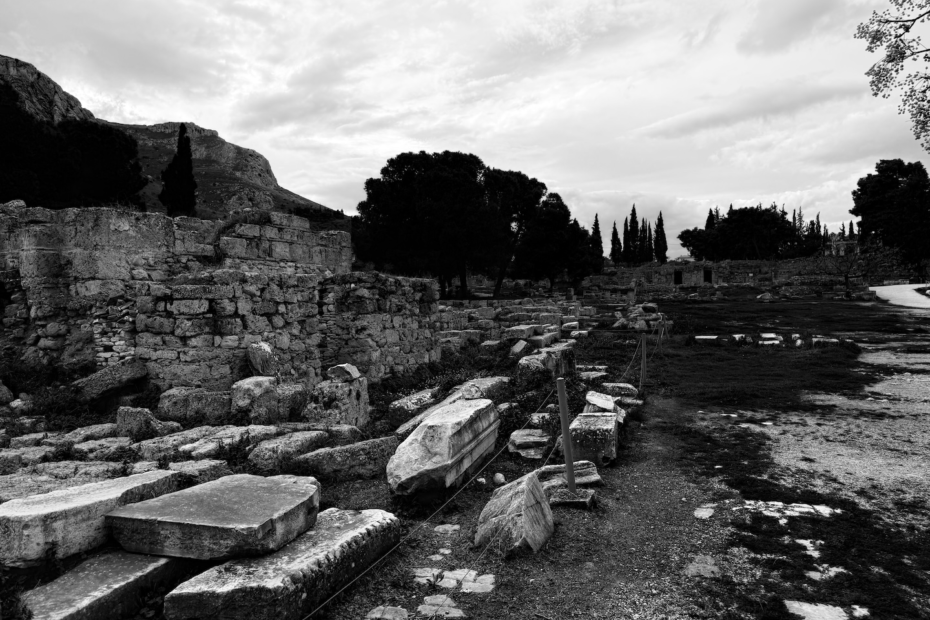
Well folks, the last month has flown by. My apologies for the delay in producing content; I had to manage multiple finals, two jobs, and a trip to Greece all crammed into the busiest weeks of the year. This post is going to differ drastically from the ones I have published over the last several months, as it will not rely solely on exegesis or political/pop culture analysis.
Introduction
I had the wonderful opportunity to participate in a travel seminar to Greece with my university this past week. This had been a life dream of mine. I knew the class would be enriching academically, but I did not expect the profound spiritual experience that would be born out of it.
The seminar was far more than a mere class. It took on a separate layer as an excavation of my own grief and the “holy place” that was once my faith.
My mother always said she felt closer to God at the sea. And the unexpected part of this trip is that… somehow I did too. Visiting these sacred spaces and seeing the gorgeous country of Greece, which I now believe to be on par with Eden, transformed the trip. It was no longer just a travel seminar; it was now also a spiritual journey that provided the healing my spirit had longed for in this literal tribulation period of my life.
Some Key Things to Bear in Mind
Before I proceed, I would like to establish some key facts. For starters, I remain agnostic. I experienced no Damascus Road moment; no visions, no voices, nor any The Shack-esque confrontations with the Godhead. I do not leave a changed man; I leave an adjusted man. Put another way, I leave someone comfortable with integrating their own shadow.
Second, the experience itself is for academic purposes. I consider learning a spiritual practice, and the real change came not from supernatural experiences but academic engagement. I cannot say that my experience would have been the same if I was visiting Greece for a personal vacation.
Thirdly, this is a narrative of learning humility in both faith and research. It is not a testimony or affirmation of any divine calling. I did not find myself in a place of elevation; instead, I found “my place in the dirt,” to borrow from the Christian metal band Demon Hunter’s infectious terminology. This contrast is crucial.
Reverence in “I don’t know”
In a class I took the previous semester, we read a fantastic excerpt from George Hunsinger’s book, Disruptive Grace: Studies in the Theology of Karl Barth. The terminology he presents, “reverent agnosticism,” spoke to me, though I disagree with Barth and Hunsinger’s treatment of my faith. I find that they are essentially co-opting agnosticism to serve a dogmatic Christian end. For Hunsinger, it is a posture of “hopeful prayer” and silence.1
That is not agnosticism. That is Christianity in a black veil. Agnosticism does not require prayer, nor is it “silence.” Agnosticism is, quite literally, “I lack the knowledge to make a personal or ecclesial claim about the divine, and as such I will not, though I will remain open to the possibility of it.”
My definition of “reverent agnosticism” would instead be: a spiritual stance that acknowledges the unknowability of a specific God or ultimate reality (agnosticism) but maintains a deep sense of awe, respect, and commitment to sacred traditions, rituals, or the pursuit of meaning (reverence).
And this term became more than a semantics debate. This week, it became a radical development in my theology.
The Trauma of the Church
I did not have a pretty experience in the American church. My family church hopped at a young age—twice—for precisely the same reason: the pastor was caught sleeping with the secretary. My youth pastor turned people away for the way they dressed and told them not to come back. If I listened to secular music, I was a sinner. If I ever drank, did drugs, or watched pornography, God would smite me. For far too long, I believed these hateful control tactics.
The crushing blow came in the wake of my mother’s death in 2019 and the onset of the global pandemic in 2020. Never ask a preacher why God allows suffering, I learned conditionally. My questions, as I descended far into my grief, were met with logical apologetics, when the answer should have been pastoral care. And the logic didn’t hold up either—I would not have devoted eight years to biblical studies on suffering if the free will defense or “We’re all going to heaven in the end!” held up under scrutiny.
And as for the pandemic? Well, this is when I needed to leave. I was a member of a small, conservative United Methodist Church that I will always cherish deeply. But instead of sitting in silence as the world burned, it gave itself the busy work of disaffiliating due to the UMC’s new LGBTQ+ inclusion.
The list goes on, but I am not here to write grievances. I am here to say that I carry a lot of church trauma.
The Empty Sanctuary
Last year, I participated in a travel seminar to Cuba. On the first day, we attended an epiphany service at a Catholic church. This is the first time I had attended church since 2020, though I would venture to say the last service I attended in spirit was my mother’s funeral. My skin was on fire. I would compare this sensation to the blood test in The Thing (1980), a violent, involuntary reaction to the heat of the environment.
A colleague who was with me on both trips said the only word to describe my expression in that service was “anguish.” And in one year, this sensation did not change. Just walking into some of the sanctuaries in Nafplio and even Meteora, the sensation came back. There were, and still remain, some unhealed wounds from my time as a Christian.
In preparation for a day in which we would visit “a lot” of churches, I did what I could to connect with my inner child. The wounded spirit I know from long ago just seeking hope. The best way to do this, I find, is through music.
After a few hours of meditation, reflection, and honest silence, I was able to walk into several sanctuaries without feeling like a contaminant or feeling the crushing weight of trauma. This was where I learned that there can in fact be reverence in agnosticism. I could perhaps write an entire post on this sensation, but for the sake of space, I believe Demon Hunter aptly sums it up once more:
I might settle for an overwhelming closure,
Though I won’t recognize it when I feel it.
~Demon Hunter, “Overwhelming Closure“
This song was on repeat this week, as these words were fulfilled in a way I never expected (read my previous analysis of it here).
Approaching the Hidden God
As I continue to progress in my research of Ecclesiastes, I find a key concept in discussing Qoheleth’s God is God’s proximity to humankind. Qoheleth, I would argue, presents a Deus absconditus; that is, the “hidden god.” The verse of origin for this concept is, of course, Isaiah 45:15 (“Truly, you are a God who hides himself”). There is a strong correlation between this concept and God’s role in human suffering.
In Ecclesiastes 5:1-2 (NRSVue), Qoheleth offers the following instructions:
“Guard your steps when you go to the house of God; to draw near to listen is better than the sacrifice offered by fools, for they do not know how to keep from doing evil. Never be rash with your mouth nor let your heart be quick to utter a word before God, for God is in heaven and you upon earth; therefore let your words be few.”
Part of my issue, deriving from experiential biases, is wanting to find a God who is totally absent. That was my initial understanding of Qoheleth’s God. These verses instead present a distant or hidden, though possibly hostile deity. To quote one anonymous person on the trip, “You don’t want to piss off the gods.”
As I reflected on my research this week, I realized that my conception of God changed drastically over just the last year.
But what Qoheleth says out loud is this: approach God with reverence at all times. While I personally am not going to this extreme, I do believe there is a time and place for reverence, regardless of personal convictions. And practicing that reverence this week brought a sense of peace that my soul has longed for for longer than I can possibly fathom.
My Anti-Testimony and the Power of Community
I could write an entire monograph on this week alone, but leaving room for mystery perhaps makes the experience more compelling. However, there is one element that cannot remain unaddressed.
For the first time since arriving at Candler School of Theology, I shared, vulnerably, what I consider my “anti-testimony” with a few of my colleagues. As a former behavioral health worker, I can attest to the clinical significance of disclosure, the necessity of getting the poison out. But this was not just venting or processing.
It was not the first time, nor will it be the last, that I share these grievances, but it was the first time I did so in the presence of people I, not too long ago, would have perceived as enemies simply for representing the institution that caused me so much trauma. In a way, this was me finally confronting the church face-to-face. Not out of anger, but out of reverence and grief.
My scrupulous mind would have once anticipated condemnation. But in the presence of fellow ex-vangelicals and people desiring (and making) change in the church, I was met with love. I was met with active listening. But most importantly, I was met with the agreement that this too was hebel—vapor, absurdity, senseless pain, and a striving after wind.
I made some of the most powerful companionships of my life on this trip. By holding space for my grief, they offered me something I thought I had lost: hope for the future of the church.
Conclusion
If I were to construct a picture of my faith, it would be very similar to the image of ancient Corinth I included at the beginning. The marble would just be all black; whether this is intentional or just for aesthetics, I will let you be the judge. The faith I once held is an archeological site generating significant, though minimal, clues about what this past life looked like.
My intention is not to restore, as current efforts with sites such as the Parthenon are undertaking. Rather, my goal is to preserve the ruins as a testament to what once was, while I break ground on the New Corinth. My foundation is the simple, yet sturdy answer of “I don’t know, but I will continue to seek.”
I find peace in recognizing my own history and learning from previous mistakes. I find myself closer to God not because of my location or divine intervention, but in the solitude of knowing that knowing not is sometimes best. And off in the distance, I can still see the sun rising over Thessaloniki, piercing the darkness.
- Hunsinger, George. Disruptive Grace: Studies in the Theology of Karl Barth. Grand Rapids: William B. Eerdmans, 2000. Pp. 242-248. ↩︎