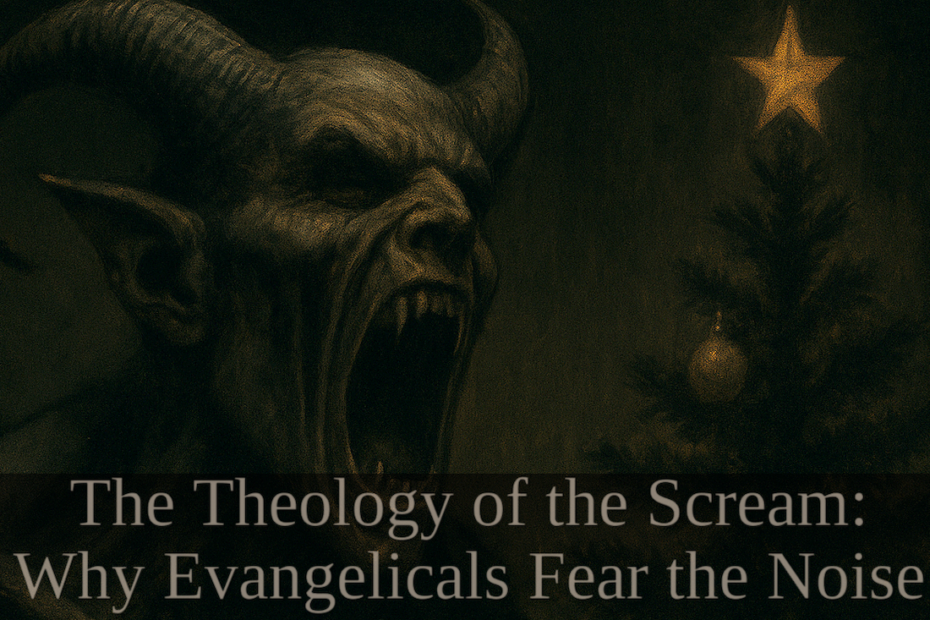
It’s Black Friday, and the country is settling into its own unique liturgy. We are surrounded by fluorescent lights, maxed-out credit cards, and lines that snake through aisles like penitential processions. We call it tradition, or simply normal, because admitting we built a holiday around hunger would feel too honest. While you probably want something light to read today, this won’t be light… entirely, at least. However, it will be familiar to anyone who has spent time in Christian culture and learned that the most unsettling thing you can do is make noise in the wrong key. This is an exploration of the Theology of the Scream.
A Hymn, Polished to a Shine
Recently, Skillet, the juggernaut of Christian rock, released their first Christmas track: a cover of “O Come, O Come, Emmanuel.” Listen here. The ten-year-old kid in me noticed immediately and would have played it on repeat, probably considering it worship. However, the adult in me, the one who has watched the machinery behind worship culture operate, listened with suspicion.
It is exactly what you would expect from newer Skillet: clean production, a cinematic swell, and a hymn treated like a product that cannot be allowed to look messy. Even the “grit” feels curated. Except that… the ending arrives. John Cooper finally unleashes some unclean vocals, an elongated scream specifically. It isn’t a playful rasp or a radio-friendly growl; it is a real, guttural scream that sounds like something breaking.
Almost immediately, the comment sections filled with the modern evangelical reflex. I guarantee you, if you look right now, you will find users claiming, “This is demonic,” or “That sound is of the Devil,” and accusing the band of ruining a holy hymn with some satanic noise. Although I do not attend church anymore and identify as an agnostic, I recognize this pattern with clarity because I lived under it for years. The panic is not really about Skillet; rather, it is about what the scream represents. It is the deep-seated fear of an unfiltered human note.
The Church’s Unspoken Rule: Keep It Pretty
There is an unspoken aesthetic commandment in evangelical culture: holiness must be pretty. It cannot just be morally pure; it must be visually clean, emotionally manageable, and sonically pleasant. Consequently, worship sets are engineered like soundtracks, doubt is treated like a spiritual defect, and suffering is allowed only if it resolves quickly by the final chorus.
We can call this a Theology of Aesthetics. In this framework, pretty equals holy, while ugly equals suspect. Grief must be softened, and anger must be sanitized so that the sanctuary remains presentable. But, the problem is… the Bible is not presentable. Not in that framework.
In reality, the Psalms do not whisper, and biblical lament does not stay within a polite volume. Psalm 88, my personal favorite, ends in darkness and refuses to fix itself for the reader’s comfort. Jeremiah is not a calm devotional voice; he is an exhausted prophet trying to survive his calling. Both he and Job regretted the days of their birth. Even the crucifixion is not an antiseptic moment. It is a public execution, a spectacle of human cruelty, and the Gospels do not treat it like a tasteful illustration. If you insist that faith must always sound clean, you end up with a theology that, frankly, cannot tell the truth.
Why the Scream Hits a Nerve
This is where my agnosticism still intersects with Christian metal in a way church culture never did. As I explored in my recent analysis of Demon Hunter’s beautiful new album “There Was a Light Here”, this genre often understands darkness better than the sermons I grew up with. The scream is not a gimmick; it is a confession without words.
A scream is what happens when language runs out, leaking out when the body knows something the mouth cannot make respectable. You can call it “ugly” or “unholy,” but the deeper issue is that it is unmanageable. It cannot be edited into a tidy testimony, and it refuses to cooperate with the “everything is fine” script. This is why evangelical culture reacts so intensely to it: the scream reminds people of the pain they are trying to pray away.
That brings me, inevitably, to hebel. Ecclesiastes names the world for what it is: vapor, breath, frustration, and the absurdity of trying to build anything permanent. Hebel is not a mood; rather, it is a diagnosis. It is what you say when you have stared at the world long enough and realized you cannot keep lying about it. The scream is hebel made audible. When I hear it, I do not hear the Devil. I hear a release valve, the admission that things are not okay, and a hymn briefly becoming honest.
The Irony: Skillet Is Still “Safe”
What makes this whole controversy almost comedic is that Skillet has spent years becoming safer. They are one of the most youth-group-approved bands in Christian music. The edges have been sanded down over time, and the desperation of earlier eras gave way to arena anthems and motivational language designed to be consumed without discomfort.
They became the kind of band the Christian market claims it wants. And yet, with one scream, one moment of aggression and imperfect human sound, the market turns on them. This proves that legalism is not really about holiness. It is about control. You can be safe and still not be safe enough. You can spend years trying to fit the mold and still be punished the moment you remind people you are human.
So, What Are We Policing?
Here is what I think is actually happening beneath the “demonic” accusations. Evangelicalism, especially in its modern worship culture, does not fear Satan as much as it fears grief. It fears rage, and it fears the kind of suffering that does not resolve into a neat testimony. Furthermore, it fears the person whose life did not improve after the altar call.
So, the culture polices sound. They do this not because sound is theology, but because sound reveals what theology is trying to hide. A scream interrupts the performance. It exposes the fragile fantasy that faith is always calm, always hopeful, always uplifting, and always marketable. But a religion that cannot tolerate a scream is not a religion prepared for the world it claims to understand.
Conclusion: Let the Hymn Crack!
To the critics calling a vocal technique demonic, you might want to ask what you are really rejecting. Because from where I stand, the scream is not an attack on holiness. It is a refusal to pretend.
If the world is as broken as Christianity insists it is, then the soundtrack should not always be pretty. Sometimes the most reverent thing a person can do is stop editing their pain. Sometimes the hymn needs to crack open. And sometimes, the only honest prayer left is noise. In the deepest, darkest pit the Psalmist found himself in (Ps. 88).
And mind you, Christian metal may be your last way to reach the angry skeptics like myself who have turned on you and your legalism.