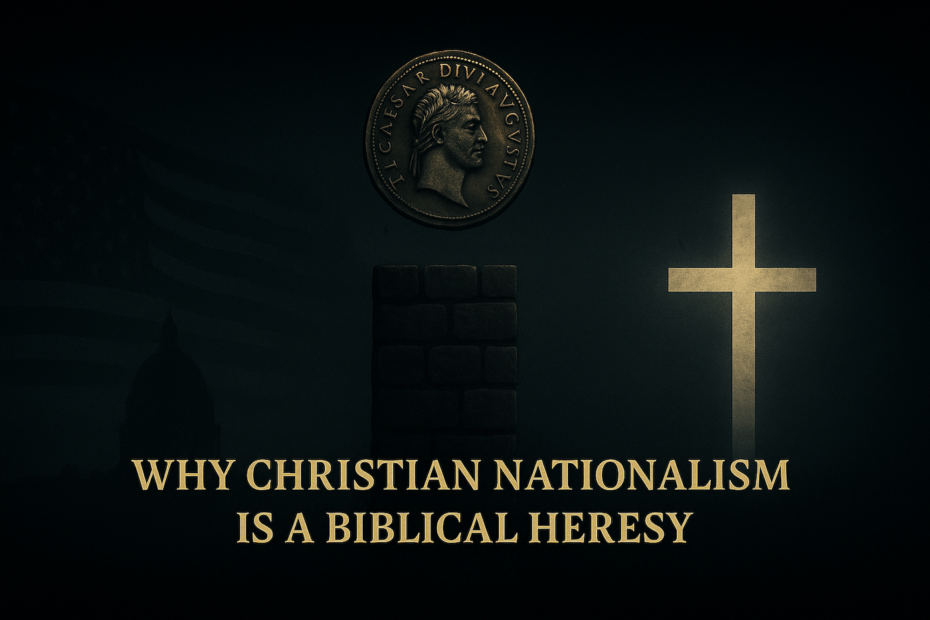
Christian Nationalism is a biblical heresy. It has become arguably the most powerful and dangerous force in American politics, with proponents insisting they are the “moral clarity” America needs. As a theologian and biblical scholar, I am telling you they are not defending Christianity. This entire movement is a profound theological failure, a systemic rot that has replaced the cross with the flag.
Christian Nationalists (CN) have a particular hatred for Thomas Jefferson’s establishment of a “wall of separation between church and state.” They see it as a secular attack on their faith. But they misunderstand its history and its theology. Jefferson coined the phrase in his 1802 letter to the Danbury Baptist Association. His point wasn’t to attack religion; it was to protect it. He believed faith was a private matter and that this “wall” was necessary to prevent the government from using religion to control people, and to prevent religious groups from oppressing those with different beliefs.
But my point here isn’t to debate or analyze the founding fathers. As a theologian, I’m interested in the fact that this ‘wall’ is a concept that goes back much further than Jefferson. It is a profoundly biblical idea. That wall is the only thing that can save faith from being hollowed out and corrupted by politics.
The Biblical Takedown, Part 1: Jesus Draws the Line
The first and most direct takedown of Christian Nationalism comes from Jesus himself.
In a moment of pure political theater (Matthew 22), Jesus’s opponents tried to trap him, asking if it was lawful to pay taxes to Caesar. The question was a brilliant snare. A “yes” would make him a Roman collaborator; a “no” would make him a political insurrectionist.
His response should be the final word on this entire debate. “Show me the coin for the tax,” he said. And holding up the denarius, bearing the image and inscription of the divine emperor, he asked, “Whose likeness and inscription is this?”
“Caesar’s,” they replied.
“Then,” he said, “render unto Caesar the things that are Caesar’s, and to God the things that are God’s.”
This is Jesus, when explicitly asked to merge politics (Caesar) and faith (God), explicitly refusing. He didn’t say, “Melt Caesar’s coin and forge it into a cross;” he said, “Give them both their due… separately.” He established two distinct realms, two different loyalties.
Some proponents will try to justify their political project by pointing to the Great Commission (Matthew 28:18-20), where Jesus commands his followers to “make disciples of all nations.” But they corrupt this passage. The command is to make disciples, not Christian states. It’s an evangelical call, not a political blueprint. Jesus himself never tried to make Israel, or any other nation, a “Christian state.” He established a kingdom “not of this world” (John 18:36), and his “Render unto Caesar” argument proves it.
Christian Nationalism is therefore a direct, unambiguous rejection of this core teaching. It is a blasphemous attempt to erase the very line that Jesus himself drew in the sand.
The Biblical Takedown, Part 2: The Prophet vs. The King
This isn’t just a New Testament concept. The “Judeo-Christian” model that CN proponents claim to follow is, in fact, built on a foundational “wall of separation” between the King (State Power) and the Prophet (Moral/Theological Power).
The Hebrew Bible is not a story of priests and kings working hand-in-hand. It is a story of prophets standing in direct, often fatal, opposition to corrupt state power (and, sometimes, a hostile and/or indifferent deity). Let’s look at two examples:
- Nathan vs. David (2 Samuel 12): The prophet’s job was not to join the king’s administration or flatter his military policy. The prophet’s job was to stand outside the palace, gain an audience with the most powerful man in the world, and shout, “You are the man!” when that king failed morally. Nathan was the “wall” separating David’s power from God’s justice.
- Elijah vs. Ahab (1 Kings 18): Elijah’s entire ministry was not a quiet negotiation with the state; it was a battle against a king (Ahab) who had merged state power with a corrupt, state-sponsored religion (Baal worship). Elijah wasn’t fighting for a “seat at the table”; he was fighting the table itself.
This is the systemic failure of Christian Nationalism. It does not seek a prophetic voice; it seeks a “Court Evangelical.” Thus, it destroys the role of the prophet and replaces them with a political chaplain, whose job is to flatter the king, not hold him accountable to a higher moral law (sound familiar?).
It turns Nathan into a press secretary.
The Verdict: It’s Idolatry, Not Faith
This brings us to the final, ultimate critique. This isn’t just bad politics or poor biblical interpretation. It is a violation of the very first commandment: “You shall have no other gods before me.”
When the flag is placed above, or equal to, the cross, when loyalty to a political party becomes more important than justice for the poor (as the prophets demanded), when “Render unto Caesar” becomes “Caesar is God’s instrument”… you have committed idolatry.
This is why Jefferson’s wall—the wall the prophets built, the wall Jesus reinforced—matters. It isn’t a flimsy fence. It’s a solid, theological barrier. It doesn’t just protect the state from the church. It protects theology from being hollowed out by the state. And it saves the prophetic voice from being absorbed into the court.
The modern church I’ve critiqued before failed because it became a hollow business. Christian Nationalism is the next, more terrifying step in that same systemic rot. It is the complete abandonment of theology in a desperate chase for worldly power.
This isn’t a revival. It is the ultimate hebel: a hollow, futile chase for earthly dominion that has, in the process, sacrificed its own soul.