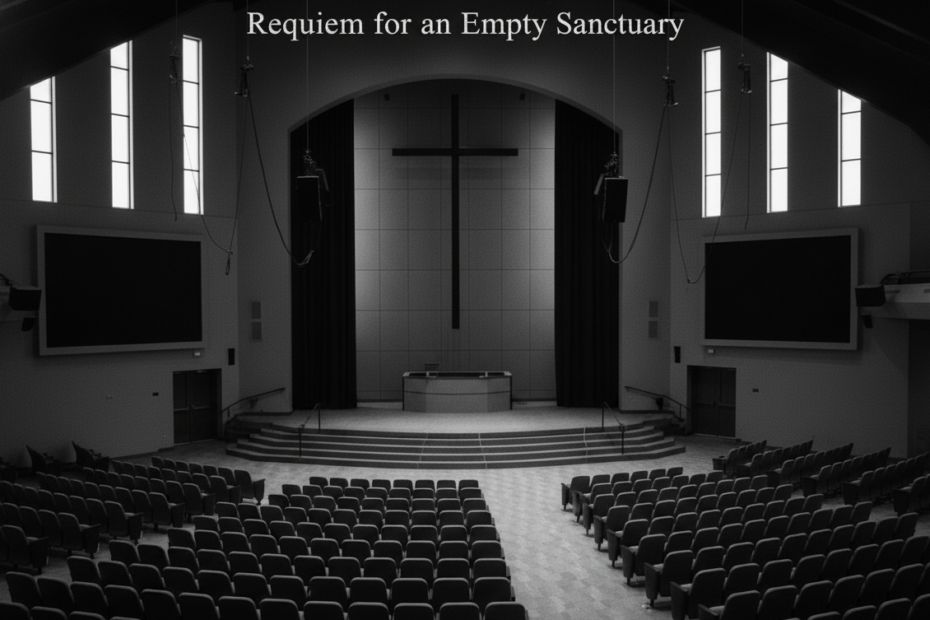
The megachurch I once worked for, a sprawling campus of five buildings at one time the largest in the city, closed its doors last month. Consolidating.
I heard the news not with satisfaction, but with a profound, bittersweet sadness. A grief, even. I poured hours of my life into that place, running cables, hauling equipment, and replacing light fixtures. Now, it’s just… hebel. A chasing after wind. An empty sanctuary.
I began working there in 2021, right as my own faith was deconstructing. It was my time seeing the “inner workings” that accelerated my journey into agnosticism. I sat in the staff luncheons and boardroom meetings. I listened as the panic grew—not about the neighborhood, not about the suffering, but about the declining attendance numbers.
The obsession was always, “How do we get people back into the walls?”
It was never, “How do we go outside the walls?”
I knew that model was broken. I knew it was unsustainable. But I never expected this. A collapse so total, consolidating from three locations down to just one in just two years’ time. This isn’t just one church’s bad luck. It’s a requiem for an empty sanctuary, and it’s a perfect case study in the systemic failure of the modern church.
The Anatomy of a Collapse: Why the Modern Church Failed
This wasn’t a sudden implosion. It was a slow, systemic rot. This institution failed for the exact reasons I had to leave.
1. It Was a Business, Not a Community
The modern church is a pop concert followed by a motivational speech, not a family. It’s a corporation, no longer an ecclesia. It is built on the metrics of a business: “cheeks in seats” and “dollars in plates.”
This corporate model focuses on entertainment, manufactured “spiritual highs,” and a flawless, flashy Sunday show. It creates passive customers, not an active community.
And the customers are walking away.
The data is no longer just a slow drip; it’s a flood. Recent 2024 research from the Public Religion Research Institute (PRRI) on religious change details exactly why. While “stopped believing” is one reason, the report shows a massive spike in people leaving due to the church’s concrete failures. The number of people who left their faith citing negative teachings about LGBTQ people skyrocketed to 47% in 2023. Another 31% cited clergy sexual abuse scandals, and many more pointed to the church becoming too focused on politics.
This closure isn’t a spiritual tragedy; it’s a market correction. This consolidation isn’t a holy merger; it’s a business correcting a failed market it no longer dominates.
2. It Offered Shallow Answers to Deep Suffering
A business cannot handle grief. It can only manage optics.
This institution failed because it actively avoids real, complex human issues. It is silent on suicide or, worse, offers condemnation. I know this from personal experience.
The system is built to provide motivational pep talks, not to sit with someone in the dark. Pastors are forced to be motivational speakers, desperate for the congregation to leave with a good feeling. But they have no answer for real suffering, for the person in crisis, for the member (me) they lost during a time of profound grief.
As I explored previously, the modern church often sells a “sentimental” faith that skips the hard parts of reality. This shallow model fails the moment a person’s life gets too real.
3. It Chose Dogma Over Reality
This leads to the core of the failure: the system consistently chooses abstract dogma over concrete reality.
Instead of addressing the mental health crisis raging within its own walls, the church I knew was more focused on abstract spiritual warfare. It is, after all, far easier to blame “demons” than to build a community that provides compassionate and loving support for real-world illnesses. It’s easier to preach a 45-minute sermon about love than to actually do the hard, messy, unprofitable work of love.
They chose the theological map over the human territory, and in the end, they lost both.
The Personal Verdict
So, yes, I grieve. I grieve for the idea of what that community could have been.
But I’m also… validated.
This closure validates my entire Beyond the Logos journey. I didn’t just leave the church; the church, as a systemic entity, failed me and has now, finally and publicly, failed itself.
The closure of that massive, empty campus is the ultimate, concrete proof, and just one example I imagine many others can relate to. My critiques weren’t just the bitter feelings of one person who slipped through the cracks. They were an accurate systemic diagnosis. The system is hollow.
And now, the walls have come tumbling down