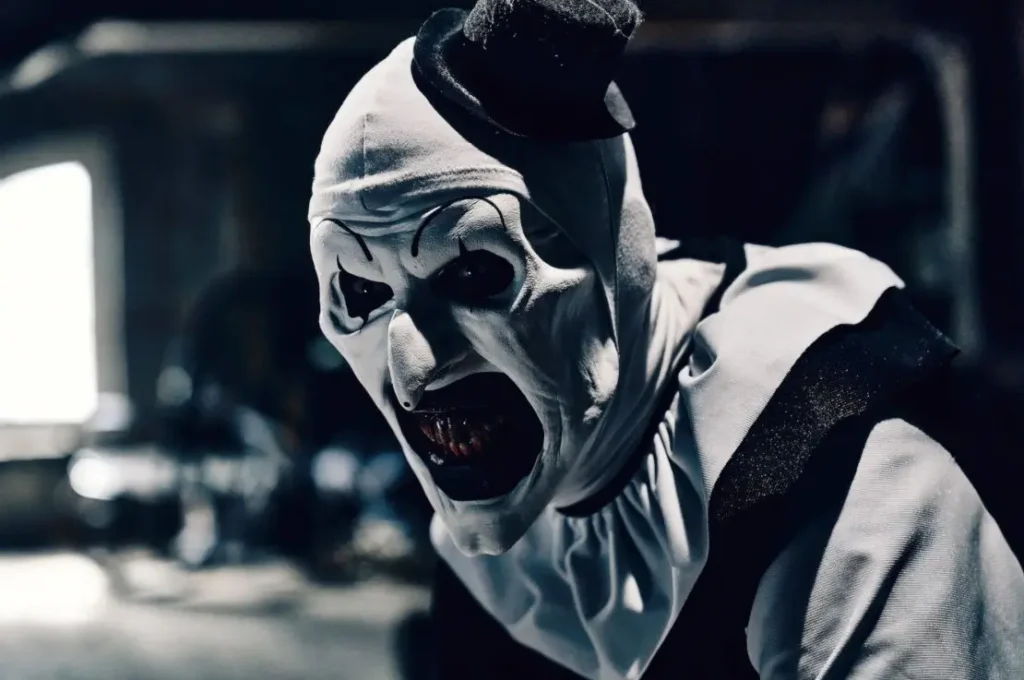
The first time I saw Terrifier 2, I felt… disgusting.
I’m not talking about a simple, visceral reaction to gore. I’m a devout horror fan; I’ve seen it all. This was different. I felt contaminated. It was a feeling so profound, yet I could not look away. The film’s antagonist, Art the Clown, is a being of such pure, unmotivated, and gleeful malice that watching him work felt less like entertainment and more like an ethical transgression.
That feeling of contamination, I believe, is the entire theological point.
The Terrifier franchise has become a modern horror phenomenon, largely because it’s so unapologetic. It refuses to sanitize its evil. And in a culture oversaturated with “clean,” “sentimental” depictions of morality, its power is in its brutal honesty. This is my thesis: Terrifier succeeds as a profound statement, and a deep dive into the theology of Terrifier reveals why it’s so potent. It’s an exploration of “concrete evil,” an act that much of faith-based media actively avoids.
The Core Theology of Terrifier: Art as Pure Absence
The power of the franchise is Art. He isn’t a human killer with a complex motive. He is silent, unmotivated, and he derives joy only from the corruption and destruction of the good.
Art is, in short, a perfect cinematic expression of the classical theological concept of Privatio Boni, the Augustinian definition of evil as a pure absence or corruption of good. Art is an ethical void. Because he is the embodiment of this absolute absence, the violence he enacts must be as extreme and grotesque as the concept he represents.
We don’t even have to guess at this. The director, Damien Leone, has confirmed this theological subtext is intentional. He has stated in interviews that Art represents a Satanic figure, and the protagonist, Sienna, is meant to be a Christ-like figure clad in armor (the “armor of God”?). The franchise intends to be a theological battleground, a literal depiction of the “evil forces at work in the world.”
The Horror of the Text
This method—using the grotesque to expose a theological truth—is not new. Before we had horror films, we had holy texts. And the people who champion “clean” media seem to have never actually read their own.
The Bible is not a “PureFlix” document. It is not a collection of gentle maxims and tidy life lessons. It is a library of war, famine, cosmic horror, and profound hebel (הֶבֶל). When people balk at this, I point them to Judges 19.
Go read it. It is, without reservation, one of the darkest, most soulless stories in the entire biblical canon, perhaps of any literature ever written. It is a story of grotesque inhospitality, gang rape, murder, and the dismemberment of a concubine, whose body parts are mailed across the tribes, inciting a brutal civil war. I must say, it is certainly a statement on moral evil.
But what is the “moral” of Judges 19? Where is the “Instant Uplift”? It doesn’t exist. The story’s function is to portray the pervasiveness of evil and violence in a way so absolutely shocking that it demands a moral and theological reckoning. It contaminates the reader for a reason.
Judges 19 is one of many reasons why, as I often tell people, the scariest books I’ve ever read are Pet Sematary and the Bible. The Bible itself understands that you cannot confront depravity by pretending it isn’t there. You have to show it. Terrifier is simply a modern heir to this ancient, brutal tradition.
The Lie of Sanitized Evil
Terrifier’s honesty feels so potent because it stands in stark contrast to the “sentimental” media that dominates “faith-based” entertainment.
The great Catholic writer Flannery O’Connor identified this problem perfectly. She defined “sentimentality” as a “skipping” of the hard process of redemption “in its concrete reality” to arrive early at a “mock state of innocence.” This is the fundamental failure of the “PureFlix model.” It “rarely acknowledges evil/suffering” at all, so its “goodness” feels cheap and false. In her own stories, O’Connor understood that “it is often by violence that the natural world… makes its mark on her characters.”
Terrifier is a film that refuses to “skip” the hard parts. It is all “concrete reality.” Its honesty about the depths of depravity is what makes the battle against it (waged by its protagonist, Sienna) feel earned and real, in a way the “Instant Uplift” of a sentimental faith-based film never can.
A Theologian in the Mosh Pit
Now, as a devout horror fan, I must be honest: I, admittedly, love the gore. But as a theologian, I’m trained to look for the logos within the chaos. These two parts of me are not in conflict.
As I see it, faith and horror have always been compatible. Both are obsessed with the same questions: the nature of good and evil, the meaning of suffering, and the possibility of unseen forces, whether psychological or demonic.
This post is part of a larger project for me. I recently explored a similar idea in my post on Final Destination, asking “Is God Death in Final Destination?” My goal is to find the theological worldview, however dark, embedded in the genre.
My mother probably still would never approve of my love for these films. But just because I like Art the Clown doesn’t make me a bad person. It makes me a person willing to look at the whole of reality, not just the comfortable parts. And a fan of confronting evil without a blindfold.
It’s the world of Ecclesiastes, my primary focus of study. It’s a world drenched in hebel—futility, absurdity, a “chasing after wind,” where suffering is random and depravity often goes unpunished. Terrifier is a film that believes Qoheleth. Ultimately, the theology of Terrifier is a brutal confrontation with the real, and in a media landscape of sentimental lies, its brutal honesty is what makes it such a vital, and terrifying, “work of art.”
Happy Halloween!