The victims’ escape is pointless; the pursuit is inevitable. And death comes for us all.
This grim six-word summary of the Final Destination franchise isn’t just a tagline; it’s the existential terror that first captivated me as a child. My introduction to this world came via Final Destination 3 (and I, to this day, will not ride a roller coaster because of the trauma this movie inflicted upon me). This series, alongside films like Saw, Jeepers Creepers, and Pet Sematary, sparked my love of horror. I became a devoted fan in middle school, recognizing the popular trauma of the log truck from FD2 and waiting the full 14 years for the latest installment, Bloodlines.
When I finally saw Bloodlines, I knew I had to write this piece (though I am late to the party!). The deaths were more comical than anticipated for a 2025 film, a criticism I can easily look past. The story itself was hauntingly personal. Previous installments focused on the fate of high schoolers or coworkers. Bloodlines followed a family bloodline, a tragedy striking people very much like my own.
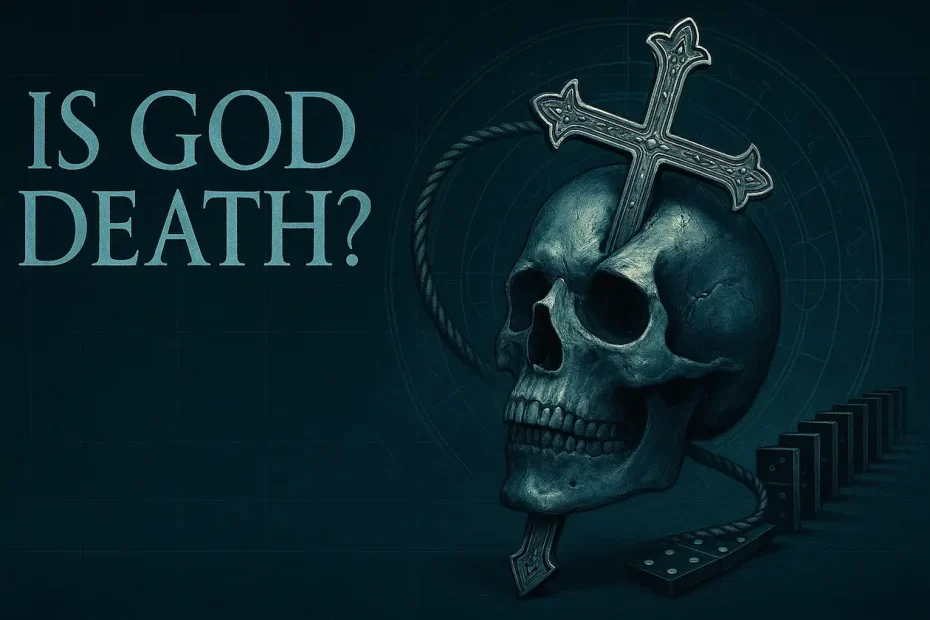
So is God… Death?
This innovative focus, where fate is inherited, instantly provided the theological connection I’ve always suspected: Is God Death? If we analyze it in religious terms, is God the villain of Final Destination?
The terror in these movies doesn’t come from a masked killer or a jump scare. Instead, it arises from a cosmic, unseen force that is rigid, petty, and absolutely relentless in its mission to restore “order.”
I propose a startling, polemical answer that goes Beyond the Logos: The entity known only as “Death” is the ultimate expression of the Old Testament Divine Will, a force consumed by the absolute priority of God’s Plan.
The victims of FD are not escaping a demon when they cheat fate in Final Destination. They are escaping the direct, punitive will of a divine entity who views human life as secondary to the maintenance of the pre-ordained order.
Theological Horror: The Written Plan (Ecclesiastes & Bloodlines)
This uncompromising framework in the films defines the entire franchise’s unique appeal to theological horror.
The futility of their protagonists’ desperate scramble for survival perfectly embodies the philosophical hopelessness of Qoheleth. The Teacher concludes that all human striving (wealth, wisdom, pleasure, even survival) is vanity (hebel), a mere chasing after wind. This is a theme you will see appear throughout my posts, as I examine the role of hebel for my thesis.
In Final Destination, survival is indeed hebel. It’s transient, meaningless, and ultimately only serves to delay the inevitable. The film establishes that there is no true “cheating,” only a brief, panicked delay before the cosmic order is violently restored. The victims’ escape is pointless because the Plan, the logos of their demise, is absolute. The innovative focus of Bloodlines on the inherited fate through generations only confirms this: the curse isn’t just for the survivors; it’s baked into their very identity.
The Divine Bureaucrat and the “Satan” Agent
To maintain my agnostic view while still engaging the theological heart of the story, we must look at how the Divine executed its Plan in early Jewish thought.
The Old Testament Divine rarely acts alone. It utilizes agents and ministers. Most famously, the Ha-Satan (or “the accuser”) in Job is not the Devil, but a member of the divine council who acts as God’s prosecutor and celestial troubleshooter. The agent’s job is to test and confirm human failure.
In Final Destination, “Death” functions as this agent. It is not an adversary of the Divine; it is a Bureaucrat of Consequence, a cosmic inspector whose sole, joyless function is to ensure that the disruption of the divine plan is fixed with meticulous, escalating violence.
The real villain isn’t the agent. The villain is the Sovereign Will that established a Plan so rigid, so non-negotiable, that its execution must sweep aside every human life that stands in the entity’s way.
Theological Horror: The Rage of an Insulted Ego (Genesis and Amos)
Why is the entity so petty, cruel, and creatively violent? Because its actions are not about justice; they are about vengeance for an insult to God’s absolute sovereignty.
- The Petition of Abraham (Genesis): When Abraham pleaded with the Divine to spare Sodom for the sake of the righteous, the patriarch was arguing for mercy over absolute rule. When God executes mass judgment anyway, it shows that the priority is not morality, but the absolute preservation of Divine authority.
- The Indiscriminate Curse (Amos): The Prophet Amos shows God unleashing indiscriminate, corporate judgment. The focus is on the nation’s violation of covenant, not the individual’s sin. In Final Destination, the survivors didn’t sin in the ethical sense; they simply violated the cosmic sequence of God’s order. God’s Plan was disrupted, and therefore, an aggressive, arbitrary correction is required. The horror is that the universe views you as collateral damage to Deuteronomy’s inflexible system of curses.
In both the film and the scriptures, the resulting terror (the innocent Billy decapitated by a piece of shrapnel from a train, the righteous family swept away in Sodom) is necessary only because a superior power has prioritized its own Order over human compassion.
Conclusion: The Ultimate Horror
The films offer a terrifying thought experiment: a reality governed by a jealous, arbitrary, and inflexible God who simply does not care about human survival when it conflicts with God’s design. This too is hebel.
The true horror of the Final Destination franchise isn’t the jump scare or the (ridiculous amounts of) gore; it’s the realization that you are not fighting an external monster. You are fighting the prerequisite for existence, a cosmic will that says “My Plan must be fulfilled,” even if that means destroying every soul that saw the truth.
This raises the ultimate polemical question for believers and non-believers alike: If God’s Plan demands such arbitrary, ruthless restoration of order, what difference is there between God and Death itself?